The advent of musical notation facilitated the creation and performance of complex music. No longer was music limited to what could be fashioned in one's head and memorized, but intricate harmonies and rhythms could be worked out, revised, and shared. Music was liberated from the mind and hands of the composer. You could now play music even if you could not compose music, at least if you could get your hands on any scores. Paper was precious, and thus so remained music.
The arrival of the printing press made music plentiful. Instead of having painstakingly to transcribe scores by hand, a process which produced not only illegibility and errors but relatively few copies, sheet music could be shared in great quantities. All that remained was the not inconsiderable task of learning to play it.
The invention of recording and replaying music at last made music cheap, and by cheap I do not mean poor, of course, but rather more precisely, costing little labor or trouble. One can now enjoy music without having either to write or to play, or even to ask or hire someone to play. You pay a modest fee and can enjoy a performance as many times as you like. Without much of an investment you can experience a massive symphonic movement or a delicate piano miniature. This ease has many virtues, the greatest of which is that one can hear performances one would otherwise never have. Likewise one can replay performances and study and compare technique and interpretation. Lastly, one can simply enjoy more music.
None of these benefits ought to be underestimated and I am not about to castigate sellers of CDs and mp3s. Yet minds starting with Plato's have considered the ill effects of putting ink to paper, wondering what is lost. Perhaps there is not much difference among the leaps to written music, then to mechanically printed music, and most recently to recorded music. The presence of written music meant that to play music one no long had to be creative, one could simply play the notes on the page. Yet this innovation seems not to have led to a decrease in composition or performative creativity. Not only did professional and semi-professional composition explode but so did amateur music writing. Likewise was it common both to write and play, but even performers who did not compose were expected to extemporize. True, few improvised like Bach and Mozart, but it was the norm for performers to have a few tricks and techniques with which to play with a theme on the fly. Mind you, it was not all excellent in concept or execution, but musical activity boomed.
Yet the popularity of recorded music has, I think, coincided with live music becoming a rarer presence, and thus music in general becoming a more passive experience. I don't mean to suggest, though, that recorded music has caused a decline in performance, only that the omnipresence of music made possible by recording has masked the decrease of live performance. Not in concert halls necessarily, has live music disappeared, but in the nooks and crannies of life. This is a rather anecdotal observation, but it seems the DJ has replaced the performer at most social gatherings, or perhaps more precisely, at gatherings at which music is not the focus. It seems harder and harder to find a space into which recorded music or worse, television, are not pumped in. Likewise informal music-making seems not so frequent. I wonder how many musicians, professional and amateur, play or sing informally in social gatherings or among small groups of friends. Is it common or acceptable at a party to begin to sing and play, or must the TV and iPod be on to entertain us?
Now recorded music is not to be regarded as an evil, but its presence reminds us that in the absence of the scarcity and struggle which necessitate certain virtues, we must cultivate them for their own sakes. In this case, although we are not forced to learn an instrument in order to enjoy music, we ought to learn the skill and cultivate the talent because making music is a meaningful and edifying activity. We will always be entertained and engaged by the virtuosi who play what we cannot dream, but there is also a place in society for casual music-making with its variety, spontaneity, happy accidents, and good humor.
So when the power went out last week and I sat in the dark listening to the charge in my iPod slowly ebb away, I realized with a new clarity that it didn't in fact house any music, but rather reproductions. Neither did the CD contain any, really, nor the sheet music. Music is someone playing, with all of the spontaneity and imperfections of the performer, the audience, and the moment, not a canned experience identically reproduced each time. So I went over to the keyboard, sat down, and promptly remembered it was electronic.
So stand we returned from our unannounced and unexpected hiatus, a hiatus precipitated by a number of factors not the least of which were, first, an inordinate quantity of Latin materials I had to make for work, and second, a rather substantial blackout in NYC. I would, however, be guilty of a lie of omission if I did not mention a few other causes of my impromptu break from blogging.
Foremost among these esoteric excuses is, I say with no small amount of astonishment, a certain intellectual fullness. Indeed it is to the surprise of my philosophical self I confess this, but I have been rather content with my mental house, pleased to dwell amidst its intellectual furnishings. I haven't been perplexed or confused or infuriated about much of anything and thus I have had little to share about being, time, being and time, positive externalities, or the contrapuntal arts. Regrettably, if satiety breeds anything it breeds indolence.
Yet the wide world of APLV is not a contentious place, really, so one might wonder why satiety or indolence or such should create lacuna of no less than four weeks. I believe it is a certain restlessness which goes hand in hand with an active mind that creates. Even if he is not grumpy per se, the intellectual has some want of understanding which drives him to poke around, in contrast to the egotist, who perceives a want of being understood. An intellectual experiences, as the Philosopher noted, a desire to understand. Of course if this is so then equally it is possible my mind had been sated by pleasures, pursuits, and entertainments apart from writing. It is also possible I briefly became omniscient, or that I am not, in fact, an intellectual. I'll leave it to your powers of induction, dear reader, to consider those possibilities.
Actually, perhaps that's a point worth pursuing. It is facile observation to note how one only has so much time in a day and all mortals have wondered how, say, Bach and Shakespeare simply had time to do so much of such quality. How did they maintain such sustained interest in narrow fields? Put another way, how could one man have had so many ideas of the contrapuntal or theatrical variety? How did his mind never drift afield, or grow content simply to tend and take what had been planted? Were they not interested in their houses, hobbies, or their wives? Perhaps this is simply the dilettante, or indolent's, dilemma. Perhaps it is the prosaic concern of an earthly intellect.
In any event I'm back to my curious, gregarious, and fussy self. Blogging resumes forthwith. Thank you for your patience.
It is with great disappointment I report that Taken 2 does not work. At all. Yes, Liam Neeson thwacking and outmaneuvering hoodlum assassins provides a good deal of entertainment, but these scenes run few and are stitched together so routinely that they don't take on any importance. Worst of all, the stitches constitute the majority of the movie.
Taken 2 picks up where its predecessor left off with the family members of the criminals that Bryan (Liam Neeson) slew in pursuit of his daughter, seeking revenge. How will they find and take him? Well while they figure that out we sit and wait. And wait. For about a half hour we wait while the characters themselves wait to go somewhere something can happen. While we wait we watch Bryan console his ex-wife Leonore (Famke Janssen) whose new marriage is ending, and keep tabs on their daughter's driving lessons and new boyfriend. Hooray.
At last, by a swoosh of the pen, everyone is in Istanbul, where we wait. We wait as the assassins keep tabs on Bryan's family as they talk on the ferry and talk in the car and swim by the pool and please let somethinghappen. As you can see the biggest problem with Taken 2 is that precious little of what happens in its 97 minutes is significant.
Finally the assassins make their move and I'll tell you for a movie titled Taken, the next few scenes spend an awful lot of time trying to prevent getting taken. This of course is necessary to some degree, Bryan can't be a pushover especially when his daughter had already been taken once before, but the scenes go on and on. The original Taken did not linger over the kidnapping and used its suddenness and the fact that Bryan couldn't prevent it to deliver a single blow. Taken held us in suspense by putting Bryan on a timetable and throwing obstacles in his path. This sequel seems to have ignored the problem that it can't add suspense by making us wonder whether someone will be taken, but only who will be taken.
spoilers hereafter So it turns out that this time around Bryan and his wife are kidnapped and I would like to add that he was not entirely helpful in avoiding this situation. You see when Brian realizes their car is being followed he gives Leonore some instructions for getting to the U.S. Embassy. I tell you I couldn't follow his instructions and I was just sitting in the theater drinking my soda, unlike poor Leonore who was being chased through Istanbul.
After the slur of stock material that is the first hour, we have some potential for excitement. Unfortunately what we get is Bryan's daughter running over Istanbul rooftops setting off grenades so he can use the sounds of the explosions to calculate where he is held. Then she drives circles around a fleet of police cars, albeit with her father's help, before neatly plopping down in the middle of the embassy.
Absurdity aside, the pacing at this point is so unsure I assumed the movie had concluded and that Bryan would rescue his wife in the final installment. Reenforcing this sense were the subsequent shots, any of which could reasonably have ended the picture. This blunder of pacing and tone makes the finale seem a hasty, unnecessary coda. Worse still, the finale cuts so many times to shots of his wife looking potentially deceased and then turning out not to be, that any drop suspense dissipates straightaway.
The final confrontation between Bryan and the father organizing these vengeance kidnappings is competent, but not totally satisfying. While we admire Bryan for trusting the father at his word to end the violence, there is no discussion at all of motives, vengeance, justice, or any ideas which could lend significance to what we see. Likewise this sequel neither acknowledges nor develops the social and political dimensions of Bryan's confrontations in Taken and thus this scene doesn't resound any themes beyond the personal conflict.
Taken 2 concludes with an off-putting disconnect as Kim's lanky hipster boyfriend sits down across from Bryan, this loving father who did terrible violence for his family. The only way this scene could have worked would have been to strike the tone that Bryan was willing to protect him too. Unfortunately, Taken 2 is entirely indifferent to ideas and the scene is played for a laugh on the old theme of the father reluctantly accepting the boyfriend. Ha ha.
The failures of the recent Presidential debate and the "Rumble in the Air-Conditioned Auditorium" got me thinking about just whom I would like to see debate the 2012 candidates. Here is my list of individuals I think would hold candidates' feet to the fire and articulate the philosophy of liberty.
From 2004-2007 on his KFI radio show Ziegler demonstrated a powerful ability, part perspicacity and part research, to observe events over a long period of time, noting many overlooked details, and then stitch them together to nail an opponent. I think any debate with Ziegler would demonstrate the saying that a liar ought to have a good memory.
I would love to see Obama and Romney debate Epstein's breadth of legal understanding, seemingly instant recall of cases, and the sheer speed of his delivery.
Jillette and Stossell are both today's great libertarian "everyman." No other well known libertarians can convey so purely the sentiments, "What more do you want from me?" and "Why can't you just leave me alone?" Against either Obama and Romney would look pushy and authoritarian.
Gillespie is simply tops at demonstrating how the answer for some people is always, "more governmental power." His opponent would instantly become the "Moar Cowbell!" candidate
I don't like Bill O' Reilly or Jon Stewart. I don't find them particularly wise or informed, or articulate or funny. Both have a talent for interviewing, Stewart teasing out inconsistencies and O' Reilly holding someone to a single point, yet neither can be considered an intellectual by any stretch of the imagination.
Furthermore it is this general ignorance of the law, history, economics, political science, and philosophy, coupled with an inability or unwillingness to think systematically, which wafts the odor of pandering from their million-dollar studios.
I don't intend to analyze every element of this debate, which was nonetheless entertaining and provoking despite the participants' intellectual shortfalls, but I would like to note their premises and their answers to the question, "What do you think is the biggest problem in America?" I hope in simply laying out their ideas one may see them for what they are, and are not.
I. Stewart's main thesis is that America is a social democracy and that from the times of the pilgrims Americans wanted stuff for free. Americans, he said, essentially wanted socialism so they created Social Security and Medicare et cetera, therefore wanting more socialism. He did not address the many logical, constitutional, or moral implications of this assertion. He specifically rejected the idea that a citizen has to agree with everything the government does, though he did not define this position as majoritarianism or discuss this principle's impact on individual sovereignty. He adopted the progressive notion articulated by Wilson that democracy and socialism are in essence the same (see Socialism and Democracy.)
Curiously, Stewart said that the biggest problem in America remains that our political dialogue is about socialism and capitalism, or freedom and tyranny. To Stewart, America has socialistic governmental institutions thus they're here to stay, and preferably grow. Aside from this being inconsistent with his aforementioned majoritarianism, it is also takes for granted that these institutions work or can be made to work. He wants not less government but efficient government, completely bypassing the fact that no monopoly of any kind is ever efficient.
Lastly, because according to Stewart America was, is, and by right ought to be socialist, President Obama's policies are not fundamentally transformative.
II. O'Reilly's premise seems to have been that America was not socialist and is not and ought not be and President Obama is therefore fundamentally transforming America. He refused, however, to admit that any American program is socialistic in principle and argued that only at some degree does a program become so. Stewart even pressed him as to why he thought the progressively taxed Social Security program was not socialism and O' Reilly did not have a satisfactory reply.
To the question of America's greatest problem O' Reilly answered that capitalism rewards the greed which drives people in the media to lash out and tear people down. There was no follow up about whether this was true or what one could or ought to do about this.
If in describing O' Reilly's ideas I am brief only because they seem so close to those of his opponent. Stewart wants unlimited socialism and O' Reilly wants to restrain it at some arbitrary point. They both adore Robert F. Kennedy Jr.
–
With respect to rhetorical prowess, I don't think either man debated well. Anyone trained in rhetoric and oratory would have cleaned their clocks. Stewart's comedic antics tired me and distracted from the issues as they usually do, as did O' Reilly's paternalistic finger wagging. Neither man had a firm command of the facts, especially historical, legal, or economic ones, although O' Reilly had clearly done some math homework. Structurally, this was certainly more of a debate than the recent presidential one which, as has been pointed out, was more of a joint press conference. Stewart and O' Reilly truly and admirably engaged each other, and mostly in good spirit. Neither debate, however, was well-structured or competently moderated.
Overall what The Rumble lacked most was a discussion of first principles. Both men dealt in caricatures of the other's ideas, but neither seemed to have any first principles of his own to articulate. Thus the debate about domestic policy was debate over how much, not whether. The debate about the debt devolved into a blame game. The foreign policy discussion never approached questions of actual policy, only criticisms of particular actions. And so on. I don't believe any mention was made of the Constitution at all. The Rumble is useful insofar as it provokes discussion, but it certainly doesn't recommend these men or their ideas. The two anchors ended on the note that neither man could imagine disagreeing so fiercely with someone that he couldn't engage him and discuss the ideas with him. A bright spot.
Tom Woods's remarks in a recent Mises Institute lecture brought to my mind the gaggle of grousing South Park denizens who, whenever anything threatens their income, complain that, "They took our jobs!" Regardless of the causes and their own actions, these citizens ascribe all guilt to some thieving tormentor who has robbed them of their God-given livelihood.
Never mind whether society actually needs their wares or crafts, whether they could have differently saved or invested, if they could have changed careers or locations, and so forth, these people cry, "They took our jobs!" The obvious implication is that someone must make up for their loss, and hence Tom Woods's perspicacious comments reminded me of their demands.
It is terrible to see your expectations and plans fall out beneath you, but that's only because your expectations and plans were at odds with everybody else's expectations and plans, and a market correction is precisely that, it is the realization of precisely this problem: that there has been this lack of coordination. So why should everyone else have to suffer to pay for the stimulus to make some people whole. Why would that be socially desirable for everyone? A market correction is the way individuals say through their buying and abstention from buying that the previous array of prices was too high and we want to see them lower. Who is the government or the federal reserve to second guess that?
And the people whose lost in the bust are going to be in the forefront, demanding stimulus to re-inflate a tire with a large hole it, but other individuals have interests too, and those interests do not necessarily lie in ensuring that some arbitrary asset once again reaches some arbitrary price level. [1]
What strikes me most about Woods's words is the word arbitrary. No good has a fixed value but rather, as Woods has said in tidy summary of the Austrian science of human action known as praxeology, "The very act of choice... implies cost." [2] So why should any given good have its price inflated higher than what customers will freely spend for it, or reduced to lower than what is worth to its owner? Why would any good be deemed special? Why would any group of workers buying or producing that good be deemed special? Besides, the value of the good is never fixed for either the producer or the consumer.
For the producer, the price might be lower when he has streamlined production or it might rise with rising costs of materials or from the pressure of a wily competitor. For the consumer, his resources, needs, and wants can vary from time to time, thus his willingness to pay a given cost can vary. Customers and producers adjust to these fluctuating variables, supply and demand, in a free marketplace, buying and selling goods if and only if they think the exchange gives them what they want at that time.
If the iPad costs $500, some people will pay for one and some won't. If Apple profits from selling the device at $500, then that means the iPad is worth $500 to enough people with $500. Both parties win. If Apple sells too few to profit, they must either charge more for it, or construct it with fewer resources so they can charge less and thus sell more of them. Where does government or Federal Reserve or any third party get the authority (legal or moral) or knowledge to tell Apple how much it costs to make an iPad (by way of telling them how many people to employ and/or how much to pay them or how many they can sell) or how much it should profit from the sale, or the consumer what the subjective value of the gizmo is to him?
Apple is but one example, but why should any industry, that is, the employees and entrepreneurs of any industry, be prioritized? Why ought the price of steel remain high to benefit steelworkers when efficiencies might make it cheaper to the benefit of people who purchase steel? In any of the following examples, why is one party more important than the other? How could any of the following statements be justified?
The price of automobiles must be kept high by means of bailouts enabling the company to employ more costly workers, to protect auto workers at the expense of those who buy automobiles.
The price of grain must be kept high through subsidies, to protect farmers at the expense of those who buy food.
The price of American goods must all be kept high by protective trade tariffs, to protect Americans who sell goods at the expense of Americans who buy goods.
The price of houses must be kept high through stimuli to protect home owners, real estate salesmen, and construction workers, at the expense of those who want to buy houses or to rent.
Companies must be bailed out to protect shareholders, at the expense of those who do not speculate with their savings.
Why should spending be encouraged through low interest rates, at the expense of those who save?
To justify any such assertion is not only to plan the economy, but society.
[Periander] sent an agent to Thrasybulus [the tyrant of Miletus] to ask what was the safest kind of government for him to establish, which would allow him to manage the state best. Thrasybulus took the man sent by Periander out of the city and into a field where there were crops growing. As he walked through the gain, he kept questioning the messenger and getting him to repeat over and over again what he had come from Corinth to ask. Meanwhile, every time he saw an ear of grain standing higher than the rest, he broke it off and threw it away, and he went on doing this until he had destroyed the choicest, tallest stems in the crop. After this walk across the field, Thrasybulus sent Periander's man back home, without having offered him any advice. – Herodotus. Histories, V.
–
"It is time that equality bore its scythe above all heads. It is time to horrify all the conspirators." –Maximilien de Robespierre
–
Leveling is the barbarian’s substitute for order. –Nicolás Gómez Dávila
You bought the tickets, cleared your work schedule, hired the babysitter, and finally you and the madamina head to the theater. Phantom. Smoke, mirrors, chandeliers. Oh boy! Unfortunately when you arrive, the theater has been "renovated." Now the seats encircle the stage and you can see past the it to the people across. They yawn, chew gum, shift in their seats, but you can live with it. It's Phantom, after all.
So the curtain goes up and you await the overture, only to hear the march from Raiders of the Lost Ark. There's nothing wrong with the Raiders theme, but it's in the wrong key, the wrong genre, the wrong meter, and thematically it doesn't relate. Sure it is rousing like an overture, but it's completely out of place. The "overture" ends and you, avid connoisseur of the theatrical arts, persevere.
So the chorus comes out dancing and twirling as all seems well. Then the prima donna steps out and strides to center stage. Her whole body is poised to let forth a torrent of bravura virtuosity and at last she opens her mouth. . . and tells you the piece you are about to hear is in D major, common time, and at allegro tempo. "It can be found on page 75 of your score," she adds. Now you're pretty ticked. Is this a rehearsal? You glance at your wife in disbelief, but what are you to do? Walk out? Of course not, so you sit and nod off as the show goes on.
Eventually the Phantom himself stalks onstage, his ivory mask glinting under the theater lights. Your spouse nudges you awake. The titular seducer coos:
Night time sharpens, heightens each sensation
Darkness stirs and lessens consternation
Silently the senses walk out on their defenses
Slowly, softly night uncurls its splendor
Touch it, sense it, tremulous as ever.
"He changed the words. Why did he change the words?" You think to yourself. "They're not bad words, but they are the wrong words. I don't get it." Then the Phantom looks up and starts singing at the audience instead of at the leading lady. What's going on?
You're so focused on the oddities that the song is over before you realize it. The two bickering theater owners have entered for their scene, but something is off with them too. At first you can't place it. They're speaking and their words make a certain sense, but something is missing. There's no direction to what they're saying, they're ad libbing. And badly, at that. Eventually they're just rambling. At this point you're hoping the chandelier will fall on you and end this madness. Instead, the choir enters (late and off key, because they didn't rehearse) and starts singing the finale to Les Miserables.
Just suppose any Broadway performance went so awry: it would make the newspapers. Yet similar liturgical follies occur weekly, daily even, at churches everywhere and parishioners don't kick up much of a storm. Explanations of the phenomenon abound: indifference, philistinism, Sandinistas. It is possible, however, some virtue lies at or near the heart of this curiosity.
On the one hand, art is an aesthetic experience. If the execution fails, the purpose fades. The purpose of the liturgy on the other hand, is not primarily aesthetic. Its execution may be poor, but excepting outright abuses, its purpose endures, hence people go to church despite the exceedingly poor art of celebration. In this respect, the faithful permit the aesthetic degradation because there is virtually nothing the priest can do which will turn these parishioners away. Why sing Palestrina when the status quo will do? Why prepare a homily when off the cuff remarks will suffice?
The faithful who would express the liturgy through the transcendent power of art have a few fates. Some are democratically stifled, others learn to stifle themselves. Some will sit and seethe, others will leave for greener pastors. A handful of crusaders may take up arms against their priests, organists, and music directors, making a lot of enemies in the progress. What seems to me the most productive path is likewise the most challenging. A few thoughts.
First, people will be persuaded by different arguments. Some will find liturgical laws compelling, others will find them onerous. Some will be roused by paeans to beauty, others will find them highfalutin. Choose the appropriate argument and remember you need not persuade someone on all accounts.
Second, do as much as you can. Make phone calls, make appointments, make reservations, make copies. This will relieve other people of the responsibility, which many people welcome, and it will in many cases give you the liberty to make decisions. That said, don't angle for more authority or other peoples' jobs. Just do as much as you can as well as you can, if you carry out those tasks well, others will come.
Third, do everything as well as possible. Neglect no detail, aim for perfection. Some people will notice right away, others will notice when you aren't the one arranging matters.
Fourth, get creative. If you don't want guitars at mass, then organize some other event at which those individuals can perform. If rehearsals for that new event should happen to coincide with rehearsals for mass or mass itself. . . Find a way to keep them involved, but not crooning through the liturgy.
Fifth, be the alternative. Always have your plans ready to go at a moment's notice. When there's a blip in the status quo or when nothing else is ready, you'll be ready to jump into action, pulling someone's fanny out of the fire while giving people a taste of your vision.
Sixth, think big and small. It's all very well and good to aim for an EF or Latin NO, or a piece of polyphony at mass, but think small too. Sometimes a grand gesture is needed, sometimes a subtle one. Aiming to add or remove one piece of music, better train the altar servers, or improve the website might be the falling of stones which starts the avalanche. The better you can make any one part, the worse the shoddy elements around it will look and the more others will be amenable to tweaking them.
Seventh, thank people. Everyone, preferably. Bring them into the game. If they don't do anything, ask them a question and then thank them "for their guidance." Also, if you mention a group or committee, then you better know the names of the people in it.
This is no small task, but what more could be at stake?
The choral fugue has long been the crown with which composers consummate their greatest works. From the leaping dances of Bach's B minor Mass to the flashing fugatos of Handel's Messiah, these choral coronations become the most memorable moments of the works. Such is in part due to their functions within the pieces as celebratory climaxes, but we need look only as far as Theodora for a finale grand and sombre.
Bach and Handel have in these pieces, with their expressive harmonies and vigorous rhythms which threaten to break free from all restraints, the perfection of their geniuses. For this good reason the music is much and well commented upon. Yet Haydn's genius too saw in the choral fugue's counterpoint not just the frame for a grand finale but the potential for depicting and amplifying an idea. Haydn would find for the nature of the fugue, with its many contrapuntal variations, ideas which themselves would flourish in such development. In his oratorio The Creation he found some ideal subjects and set to work.
I. The first of the three great choruses of the oratorio concludes the Third Day of Creation.
Stimmt an die Saiten, ergreift die Leier!
Lasst euren Lobgesang erschallen!
Frohlocket dem Herrn, dem mächtigen Gott! Denn er hat Himmel und Erde
bekleidet in herrlicher Pracht.
Haydn's choral fugue for, "Denn er hat Himmel und Erde / bekleidet in herrlicher Pracht," is not simply a ride over thrilling rhythms, but the many entrances are appropriate to the logic of the text: the draping of magnificent garments. With each entrance we feel the hand of the Maker twirling pure splendor around his creation.
II. The choral finale to the Fourth Day is well-known to English speakers as "The Heavens Are Telling" and it fares translation better than other movements. By what better way to display the myriad wonders of creation than by counterpoint's manifold arts of inversion, diminution, augmentation. . .
Die Himmel erzählen
die Ehre Gottes
und seiner Hände Werk
zeigt an das Firmament.
III. Effective though it is, Haydn's conclusion does not seem to live up to the previous movements, at least with respect to putting the counterpoint to inventive pictorial use. Perhaps the concept of praise doesn't admit to much development or lend itself to any contrapuntal expression other than, "every which way, forever," perhaps it's simply a perfect, if obvious, fit.
Just a little something I dashed off to friends in one of my surlier moments.
I cannot begin other than condemning today's bipartisan indifference to the cataracts of red ink bilging forth from Washington. That said, I pine for no other form of cooperation than toward the diminution of executive, legislative, and judiciary authority (I think it's a sham to call the apparatus "federal" at its present degree of authority.) Mindful of the aforementioned and in the spirit of this spirited thread, I don't find the Romney/Ryan plan of reducing the rate of increase (of authority and spending) much more palatable, let alone laudable, than the present (and previous) administrations' indifference toward liberty and solvency. Likewise I find the clueless haste with which Bush et al passed TARP outmatched only by the double-barreled imbecility of President Obama and his toadies' passage of the turgid and impotent ARRA. I pass over the unaccountable accounting of the Treasury and the Fed's ruinous and fruitless QE, which seem to be of no consequence to the populus, its governors, or its legislators, who patiently wait for these problems to swim up and bite us in the ass.
Ideologically, I have no sympathy with the Progressive's impatience with and disdain for the Constitution, the hippies' disco-era Marxist bastardizations, or the Clintonistas who envisioned the end of history during the merry rule of Slick Willie. Likewise the GOP, whose most recent representative in the Oval Office called, after 9/11, for all Americans to go shopping, is a first rate sham, a sham which has been successful at conserving only the mistakes of its predecessors, conservative and progressive alike. The present political climate, stripped of its plumes and spangles, is one in which decent citizens put aside their intelligence, sagacity, and good humor, willfully to see in political bunkum their own ideologies, and then not only to shill for the exponents of said bunkum, but to vote supreme power to such rogues and scoundrels they would disdain as neighbors. As for compromise, I'm not holding my breath for the genius of Cicero to step into the Capital Building and breathe forth the spirt of Concord onto this august body of miscreants. There is, however, a certain Laputian doctor with what seems a wise measure. . . and he could also supply the honorable Charlie Rangel with some apophlegmatics.
Stefan Knüpfer is not a famous man. His name graces no concert marquees or programs. Somewhere at the back of an unread CD insert, perhaps, he is listed as, "Steinway Technical Director," an appellation which tells us nothing of either his gift or his skill. Mr. Knüpfer's gift is a set of golden ears, attentive to the subtlest overtones and shades of pitch. His skill is a peerless finesse for tuning that Cadillac of the concert hall, the Steinway D.
At the piano Knüpfer is quite a sight certainly for the layman but even for a musician: endlessly ratcheting at a string, trying to tune away a little sharpness, or fidgeting at a hammer trying, to coax out an overtone. Yet for all of the excruciating harmonic minutiae there is never any dullness to Knüpfer or his task. He has the aficionado's enthusiasm and the master's attention to detail and watching him work is an impressive sight. Whether tuning the strings for an elusive tone or measuring hammers to the millimeter, we see, perhaps for the first time, a mastery of this machine quite distinct from that of the pianist. And indeed the piano is a machine, however much we might restrict our notion of machines to boxes of cogs and vast industrial apparatuses. There is at any rate little doubt when in a bravura moment Knüpfer hauls out the entire action of the piano, revealing the circuitous complexity of the massive sound machine, his little kingdom.
As king, however, Mr. Knüpfer also serves, and he serves the needs of the piano's more flamboyant master, the pianist. Flamboyant and particular, so much in fact that the pianists' presence in Pianomania is downright chaffing. Which wants a little more sharpness here, a little less there. Who wants a wider sound, or a narrower sound, or something in between. Brighten this overtone, clean up that decay. One is too thin, another full but too late. Not all of the pianists make so many or such specific requests. Alfred Brendel and Lang Lang make a few of each, Rudolf Buchbinder practically none, and Pierre-Laurent Aimard, well let us say the majority of the film traces his quest for the perfect pianos on which to record Bach's Art of Fugue. He wants one that sounds like a harpsichord, another like a clavichord, another like an organ. . . a pursuit which reaches an absurd apex when he requests a piano which is more banal.
Some of these scenes hit a comedic pitch as the two struggle to describe acoustic phenomena with a nonexistent vocabulary. At one point Knüpfer resorts to some hand gestures which become so silly he and the engineers burst out laughter. The precise temperament Aimard seeks may seem absurd to us, it certainly did to me, but Knüpfer is forgiving. "The moment his fingers touch the keys," Knüpfer says, "he tells you exactly what you did. It's fascinating."
Music is not at the center of every moment of Pianomania, however, especially when Mr. Knüpfer meets his most raucous client, comedian-pianist Hyung-Ki Joo. After tuning the instrument, the two share ideas for some musical skits a la Victor Borge and Knüpf plays quite a laugh, painstakingly replacing one of the piano's legs with. . . well I won't spoil it.
Pianomania, though, is not a paean for master tuners or a wagging finger at prima donna pianists. If anything Knüpfer is sympathetic to the pianist's endless quest to find just once in the world the perfect tone in his head. Pianomania then is an ode to beauty, the pursuit of its pure form in pure tones, and the instruments which, if cared for and wisely played, can produce such immaculate sounds. Such is his affection for a beautiful tone, Knüpfer confesses, that he turns off the radio when he can't stand the bad sound coming out of it. Mania perhaps, but being held by beauty is a rapturous madness.
If you enjoyed this review you may also like the following reviews:
Art critic Robert Hughes wrote and narrated this documentary on Caravaggio in 1975. The section below begins Part III, the film's highlight, in which Hughes shares his perspicacity with a series of lucid and illuminating descriptions of Caravaggio's best works. Beside Hughes' lively comments is a soundtrack of wisely chosen music complementing Caravaggio's masterpieces.
I entered The Bourne Legacy having retained nothing from the preceding Bourne films, save whiplash. I left The Bourne Legacy having learned nothing about the intrigues surrounding Jason Bourne or this film's hero, Aaron Cross. Does it matter? Not a bit. Legacy gets away with this gaping lacuna because the film is about not knowing. It's about the effects of secrets, secrets on top of secrets and within secrets. It's about secrets spreading like poison through unnamed government programs and threatening to topple agencies, agencies headed by people who don't report to anyone so long as crises are kept out of the news.
Unfortunately for Aaron Cross, he not only carries a secret, he is a secret, and whatever agency enlisted him is now burning the program. Everyone goes, the research stays. Jeremy Renner is a persuasive everyman and we feel the weight of the hundreds of billions of dollars of resources brought down on his head. We too shrink under the thousands of surveillance cameras overhead in drones, on the streets, and in buildings. All of this weight is multiplied by the fact that he doesn't know the motives of his hunters.
As omniscient observers, though, we see not only that Cross is in the dark, but most everyone as well. In a low-key scene early on, Cross, making his way back to civilization through mountains, enters a CIA safe house. Inside an agent minds the house. Or is he an agent? Who is he, what does he know about Cross, about Bourne, or about anything? Does he always mind the house or has he been planted there to meet, or dispatch with, Cross? Over some gruel the two men realize the alienating consequences of their business. "Are you testing me?" Cross asks the agent who no doubt wonders the same. This constructed ignorance is not limited to the operatives on the ground either, since even the CIA director and the important-looking admiral remain partially in the dark. The only man with the whole scoop on this project is its head, Col. Eric Byer, USAF (Edward Norton.) When he decides the program has been compromised, the higher-ups can't ask any questions and must go along with the clean up, if only to save their skins. Everyone else is just following orders or, in Cross' case, running for his life.
"Clean up" of course is one of those Orwellian euphemisms like pacification, normalization, and containment which masks the brutality of the act. Yet if Legacy had limited itself to portraying the besieged Cross it would not have seemed quite so brutal. While we sympathize with him, we don't quite feel pity for Cross because his extraordinary abilities seem matched to those of his oppressors. He simply lacks their resources. In one of the film's few light moments, after Cross makes an impossible getaway, a CIA desk jockey tracking him asks what he's armed with. Byer responds, "A rifle," and, embarrassed, adds, "A big rifle."
Spoilers hereafter.
We find a more sympathetic, or rather, more helpless, character in Marta Shearing, a doctor at the medical-pharmacological corporation Sterisyn-Morlanta, a corporation with some substantial government contracts. Shearing conducts research on breakthrough chemicals used to increase the mental and physical stamina of agents and, when Byer scraps the project, her team is wiped out. Surviving the purge by sheer luck, agents are dispatched to dispatch her before she can leave the country. Cross and Shearing finally cross paths in the attempted hit and the ensuing fight is for my money the best in the movie. The scene makes excellent use of the space inside Shearing's dilapidated house, which, with its stark white interior and sheet-covered furnishings, becomes an extension of the snowy outdoors. The result is a scene compact and striking, but not visually exhausting.
So why has Cross sought out Dr. Shearing? To get more of the enhancing pills, or pharma, as the addicted agents refer to them. He chose her because she had administered his physical dozens of times and quite simply, he remembered her. Shearing, however, does not recognize him at all, much to his astonishment and even anger. "What did you think you were doing?" he demands. She replies, aghast at her meager excuse, that she just "did it for the science." Flustered after Cross' barrage of questions she asks to be let out of the car and he lays down the hard truth that her science has become a death sentence. Paraphrasing, he tells her, "What are you going to do? Call your friend of a friend, or that guy who works at the Washington Post? Do you think you can get to him so fast that these people won't try to finish what they started?"
The remainder of the movie is competent and entertaining although it proceeds along regular lines. Weisz and Norton, as usual, give to their characters subtle secondary characteristics. Norton is aggressive and near manic, heedlessly pulling his rank because he knows the hell coming down on his head if Cross gets away. Dr. Shearing seems relegated to the distressed damsel shtick but we would be wrong to overlook Weisz's performance. Her Dr. Shearing is a brilliant professional who one day gets swept up in a web of intrigue and violence she never dreamed laid just beyond her lab. Shearing is analyzing what's happening as fast as she can and trying to follow Cross' lead, but she's out of her realm. She's pale from the sudden and relentless fear, in contrast to Cross, whose flushed complexion evinces the edgy, stimulated zone he's pushed into by his pharma. Legacy is no potboiler and there is thought in and effective execution of the details.
The Bourne Legacy could have veered off into typical action territory with its familiar cliches: the massive conspiracy that "goes all the way to the top," the bloodless businessman out to become richer, and so forth. I wonder if there remain today any conclusion which could satisfy a film of intrigues like Legacy without falling into cliche territory. Legacy avoids the problem by suppressing the catalyst for the chase: it's just about the chase. It doesn't condemn any particular enemy but makes us ask, what could be worth this? What's worth all of these lies, this web of secrets, this contrived hierarchy of ignorance? Even the most casual observer surely looks askance at the overwhelming force, wielded swiftly and absolutely by appointed and internally-regulating officials, brought down on one man. Amidst his current adversity Cross remembers a talk Byer gave him about their role as agents, declaring they get filthy in the field and do evil so that everyone else can keep themselves clean.
Legacy leaves us with two questions. For which policy, which value, do you get so dirty, and what happens when the evil turns round on you?
I just purchased Robert Harris' 1991 book, "What to Listen for in Mozart" and to my surprise what did I find inside? Why annotated selections of the score, I found. It seems so obvious, to print a score and label the sections. Anyone who studies or performs has marked up many a score but this was the first time I had ever seen an extended section annotated before. Labeling the sections, important modulations, cadences, and so forth is an enormous aid toward appreciating the structure of the music, which can get lost amid the lengthy descriptions we usually find, laden with flowery descriptions and technical terms.
Of course any aid can become a crutch, but I think the format has potential. As an example I've digitized some of my notes on the exposition of the first movement to Mozart's famous String Quartet in A, KV.464.
Patience, n. A minor form of despair, disguised as a virtue.
–Ambrose Bierce, The Devil's Dictionary
So we're happily rocking in our moral hammock, supported by the saving threads of Aquinas when someone sidles up and serves us one of those devilishly perspicacious aphorisms any philosopher would kill to have written. In just a handful of words Bitter Bierce cuts to the heart of the matter: is patience a virtue or merely a mild degree of cowardice or despair?
Bierce clearly has in mind the Christian meaning of patience, best articulated by Augustine as that by which we "bear evils with equanimity." Patience as such certainly seems a dour virtue. Why would one prefer to bear evils to overcoming them? Such a virtue seems characteristic of the enervating Christianity Gibbon thought had taught the old Romans to roll over instead of strive. Yet this truncated quote robs Augustine of his nuanced argument which in full reads:
It is by patience that we bear evils with equanimity, lest by loss of equanimity we abandon the goods whereby we arrive at better goods. [De patientia, 2]
Augustine's point here is less the bearing of evil than the loss of equanimity, that is, self-composure, (aequus, level.) Patience then, as Aquinas goes on to say [Summa Theologica, Second Part of the Second Part, Question 136] is not a virtue which itself produces good but rather one which safeguards other virtues. Safeguards them from what? Sorrow. Yes, sorrow. Rather than being a form of despair, a dead end of misery, patience allows one to forebear sorrow rather than allow one's sorrow to overwhelm reason and perhaps, without the aid of reason, cause one to act in such a way as to abandon other virtues just to relieve himself from his sorrow.
While Aristotle makes no mention of patience itself we would do well here to observe his discussion of the virtues in the Ethics. Most importantly we should note that a virtuous man chooses the mean and not the extreme. For example, courage is a mean with respect to things that inspire confidence or fear. Thus we praise neither the reckless man nor the coward, but rather he who faces and who fears the right things, from the right motive, in the right way, and at the right time. [Ethics, 1115b] Even courage driven by passion is only courage when choice and motive are added. [Ethics, 1117a]
Though he does not discuss patience Aristotle does manage to teach us about it. First, patience indiscriminate is no virtue. Second, though it does not fit perfectly into Aristotle's framework of virtues, we see that patience still seeks the mean in attempting to moderate between virtues.
Bierce might have slighted patience but he makes a point: patience can be a mask for cowardice, indecision, and lack of passion. Patience ought to preserve virtue, which is a good litmus test to apply while one waits.
The Street Enters the House Umberto Boccioni, 1911
It is probable if not unavoidable he who enjoys music detests noise. It is inevitable he who seeks beauty avoids it at all cost. This distinction is, alas, necessary, for every aesthete knows one or a dozen musicians who though they tickle Bach's ivories by day, by night nod, nay hoof, to the bozartian splooshing of the chart-toppers. What an unhappy education, discovering the vulgar reverse of their ennobled facade! Puzzling though this contradiction is, I pass it over at this time. However frustrating and offensive such bedlam may be, its disorder is the subject of musical criticism, here not my means or end. Instead I would focus on what we might call incidental noise, and such noise in particular as produced by man. I say this not just because the whining fits and starts of a weed whacker at this very moment vex me, but because the noise of nature is always appropriate. Rustling trees and booming thunder do not perturb because wherever they are, they belong. To rustle is appropriate for a tree and to tweet is appropriate for a bird, and so forth. More importantly, the sounds of nature are always appropriate to the place, thus babbling is appropriate to brooks, crashing to the shore, and so on.
Jackhammering, however, is not natural, but rather incidental to man's desire to live in a house. It is never appropriate to any thing or any place and therefore always disturbs. We could dwell with profit on the words we use to describe what noise does to us. It disturbs and perturbs, that is, unsettles us from the prevailing order and throws us into confusion. Noise annoys, that is, molests, harms, and causes aversion. It irritates, that is, makes irate, and disrupts, i.e. breaks. Finally, noise itself, from its Greek origins means to make nauseas. Noise makes you miserable. Noise makes you want to be anywhere other than where you are.
I hope these meanings make noise seem a little less innocent. It's not just a little petty paper-crinkling. We need not invoke the power of music to observe the potential of sound. Let us rather just note then, that it is no small matter to break the silence. We ought, then, break it with some trepidation.
We break the silence to confess our love and our fear. We break it with heroic ballads and sweet nothings. We break it with sonatas and sonnets, couplets and concerti. With church bells we break it to sign the sacred and we break it with clock chimes to mark our portion of the eons. Hence, then, the infinity of displeasure through the seconds of a cell phone's half-penny speaker torturing five bars of Mozart so the caller can find out whether to record Law and Order. Hence, then, the dis-ruption from a man smacking his lemon lozenge over Beethoven's nightingales.
Focus is the mark of seriousness and appropriateness an apprehension of the nature of a place or thing. Noise, as we have defined and discussed, then, obstructs these virtues.
Yes, we all make noises, many of them unpleasant. Yet we ought not expect everyone else to welcome or deal with them simply because they are common. Imposing tolerance of common vices is no virtue, but refraining from displeasing others is politeness.
Maybe it's time we all quit trying to outsmart the truth and let it have its day. –Alfred
Spoilers!
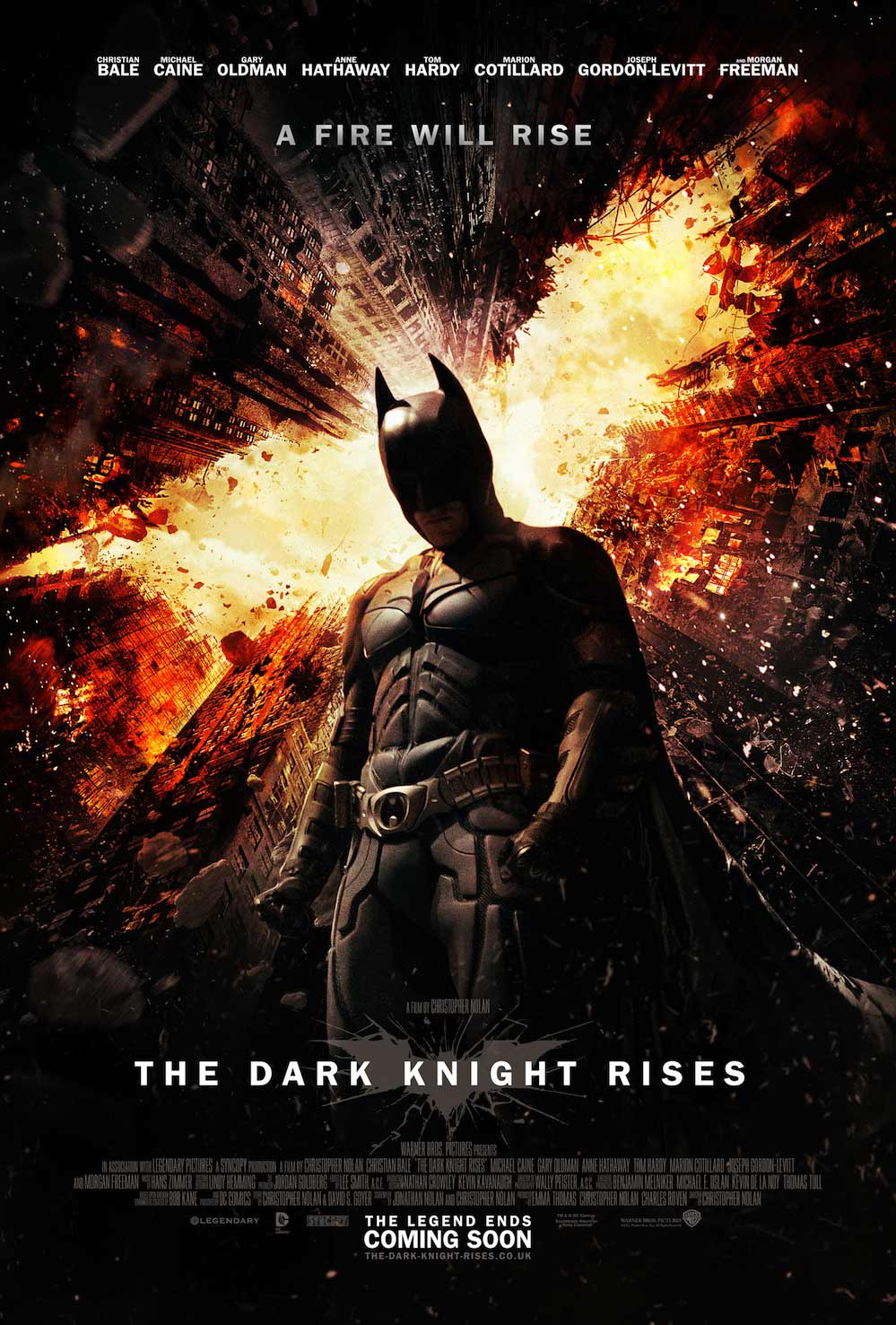
So out pour Gotham's poisons, from its wounds by the Joker. The peace Batman bought in The Dark Knight came at the price of truth and covering up the tragedy of Harvey Dent will cost Gotham. The reckoning of its sins will come in the form of Bain, a mercenary and rejected pupil of Batman's own mentor, Ra's Al Ghul.
From this premise director and co-writer Christopher Nolan crafts a brawling, blistering finale to his Batman trilogy. Unlike Batman Begins, which began by interlacing with his training the formative events throughout Bruce Wayne's youth, and The Dark Knight, which began with sequential capers featuring the Joker and Batman each dominating in their respective and then exclusive spheres, in The Dark Knight Rises Batman's bravura entrance is delayed until relatively late in the film. Instead Bane takes center stage with his bold and brutal high-jacking of a CIA jet. While TDK had Batman and Joker locked in a duel it will be Bane whose actions dominate DKR. Once his assault begins in the first scene, the rest of the film consists of attempt after attempt to stop him.
In contrast both Batman and Bruce Wayne are clearly at the end of their arcs in the trilogy and while Nolan conveys this in the plot and dialogue, the visual cues surpass and supersede. If we recall the opening of Begins the first scene with young Bruce features him falling in a well and, injured, crawling on the floor amidst a flurry of bats. In The Dark Knight we first see him hulking around as Batman on his own two feet, mauling criminals. Finally, Bruce enters The Dark Knight Rises limping with a cane. The similarity to the ancient riddle of the Sphinx, "What goes on four legs in the morning, on two legs at noon, and on three legs in the evening?" is not limited to the arc of man's growth, maturity, and decline but also to the fate of the Sphinx. When Oedipus solved its riddle the Sphinx destroyed itself and when Bruce solves it he defeats his enemies and frees himself.
Yet such freedom comes at the end of a painful and tortuous path for both Bruce and Gotham city. In Batman Begins Ra's Al Ghul sought to destroy Gotham City by scaring its people into killing each other by means of a psychotropic drug, in The Dark Knight the Joker tried goading the people of Gotham into violence by uprooting law and order, and finally in The Dark Knight Rises Bane simply decides to annihilate the population of the city. When we bear in mind Bane's ultimate goal we may realize all of the chaos and destruction Bane unleashes upon Gotham is for the purpose of breaking Batman's spirit, of making Batman realize he failed to protect Gotham and to inspire goodness in its people, and that he was wrong to think they could be saved. We can then see Bane as the combination and perfection of Ra's and the Joker.
In fact we can be more specific and say Bane is the combination of Ra's' enmity and the Joker's anger. Ra's had enmity for Gotham, not for Batman or any individual. (Remember Ra's had the opportunity to kill Bruce but was content to repay his betrayal kind for kind.) Ra's did not want the people to suffer but wished without any pity for them not to exist. In contrast the Joker felt anger toward Batman and not intrinsically the people of Gotham. The Joker wanted to use the people of Gotham to prove to Batman and all the righteous that the only way to live was "without rules." He did not want to kill Batman but to make him suffer so much that he would break his own rules and kill the Joker. Bane is the terrifying synthesis of these villains, wishing both to wipe out Gotham and make Batman suffer.
It is time that equality bore its scythe above all heads... So legislators, place Terror on the order of the day! Let us be in revolution... –Maximilien Robespierre
After Bane's successful blitz in which he both murders the mayor and traps the entirety of the Gotham Police Department underground, he plants the seeds of Gotham's self-destruction. Bane's politicking and theatricality are the means to this end and he presents himself to the people not as a ruler but as a liberator. Batman, in preserving the image of Harvey Dent, brought peace to Gotham for Dent's image inspired a special law which permitted the government to keep most of the organized crime world behind bars. Bane shatters Dent's image and the peace and not only reveals the truth about Dent to the citizens of Gotham but also releases and arms the criminals imprisoned by the now nugatory Dent Act. At last, standing in front of City Hall with his goons and looking very much like a 21st century Gracchus or Marius, Bane declares Gotham City freed from the lies of oppressors and returned to the people.
This "liberation" results in no sudden utopia but in instant violence and looting. At Bane's urging, Gotham's disenfranchised, criminals, and malcontents begin to raid the homes of the wealthy. Their reign culminates in the formation of a kangaroo court in which show trials pronounce the guilt of police and the rich and sentence them to a choice between death or a deathly walk across the barely-frozen river. The journey from storming the prison to revolutionary bloodletting has proved short.
This social war rages in the absence of Batman, beaten and locked up by Bane in a foreign prison, and becomes a crucible for a character we have heretofore overlooked: Selina Kyle. We meet her mid-heist, stealing from Bruce Wayne of all people. Wayne is quickly wise to her predicament: she has skills but she owes money to all the wrong people.
Hathaway does a splendid job with Selina Kyle, who projects confidence in her skills but a vulnerable uncertainty about who she is or what she believes. She is initially quite envious of Wayne and pitiless about the evaporation of his fortune, even claiming, unaware about what funds Batman, she does more with the proceeds of her thieving than he did with his billions. Yet Selina fears Bane even as she envies Bruce. While she looks on at the chaos unbound by Bane and the violence perpetrated by the mob against the monied, one of her larcenous friends asks her if this isn't just what she wanted: everything is everybody's. Her silence is a clear answer, but her turnaround doesn't end there. Later, in exchange for a little help, Batman gives her a computer program which will wipe all record of her and give her a much-longed-for clean slate. She now has the chance, as Bruce did, to leave Gotham to its fate. Before, she might not have approved of Bane's revolution but she refused to move against it because she thought the rich were evil, and if they were evil they deserved evil. Now, Batman's goodness and suffering has taught her pity.
She redeems her promise to Batman and this redemption is a transformation from enmity toward, if not friendship at least friendship's wellspring, kindness. Similarly, her rejection of Bane and his revolution in favor of accepting an alliance with Batman becomes a turn from envy to its opposite, emulation. Finally, killing Bane herself both fulfills her transformation from fear to confidence and makes amends for her earlier betrayal, itself rooted in fear.
Like Bruce, Selina had to discover herself, accept a mentor, and choose a path.Bruce too needed to lose himself in the world to find himself anew. He had to choose his father or Ra's as a mentor, and then finally decide what he would do to fulfill his goal. She had to continue thieving or become someone new, choose whether to follow Bane or Batman, and then finally act. She chooses to leave her past behind, follow Batman, and save him and Gotham. Selina's transformation was what Bruce long ago hoped Batman would inspire, an inspiration symbolized by the "blank slate" software he gave her to start her new life. Batman became Gotham's silent guardian by doing the unasked and not proclaiming it, and so did she. As we can see, Selina Kyle's arc is meticulously mapped and exists as an intriguing story in its own right as well as an essential thread to both The Dark Knight Rises and the trilogy.
In Selina's transformation and Bane's twin goals Christopher Nolan gives DKR appropriate themes for the finale to his Batman trilogy. These are not simply three films about Batman, but a trilogy with direction and purpose. Other characters populate Gotham city this time but they don't intersect with the themes quite so much. Lucius Fox returns but mostly as Batman's gadgeteer. In the grisled Commissioner Gordon, however, we see the toll of a lifetime policing Gotham, the exhaustion of a man struggling to preserve his honor, ethics, family, and life throughout decades of relentless corruption and violence. When we see on his face the guilt and burden of covering up Dent's crimes and betraying Batman we remember his statement from The Dark Knight, that "I don't get political points for being an idealist, I have to do the best I can with what I have." Finally, we find in Gordon an Everyman, a lifelong citizen of Gotham who one day sees a mysterious protector come to his beleaguered city, wage a war against its depraved criminals for nearly a decade, and one day give everything to a people who grew to despise him, and on that last day, in that protector, Jim Gordon found the Prince of Gotham.
Ultimately and appropriately, Batman lives at the heart of this trilogy. Now while Christopher Nolan weaves other threads, namely the nature and fate of Gotham City, he weaves them around Batman. Such is not to say they are extraneous since they are most emphatically not. The other themes, however, revolve around questions about man's nature so it is fitting the classical story of a man's growth, maturity, and end is the center. In The Dark Knight Rises, he struggles to rediscover his will when faced with the truth that he never had a future with Rachel, i.e. as Bruce Wayne. Yet Batman is either unwanted by the public or unable to defeat Bane. As a result Bruce/Batman is trapped in an existential limbo. The personal story of Batman, however, takes one the nature of a saga when we observe it takes place in the shadows of two men: Thomas Wayne and Ra's Al Ghul. Batman struggles toward his father's vision of a free and prosperous society while Bane tries to inflict his mentor's punishment on Gotham. This striking and significant symmetry lends unity to the trilogy and tremendous weight to The Dark Knight Rises finale.
Christopher Nolan's Batman trilogy is a shining example of filmmaking. It easily outclasses excellent adaptations of comic book characters such as The Avengers and Spider-man and outright shames the rest. Each film's plot is painstakingly constructed and the trilogy is thematically unified, an extraordinary feat for an original screenplay. While there are here and there convenient coincidences and commonplace elements, there is never a hint of carelessness. For the sake of criticism I tried a number of times to change re-arrange some elements of the films to see if I could not fashion some additional symmetry or meaning and each time I unravelled the film.
I initially criticized those who called The Dark Knight Rises "satisfying," as if it were a sandwich which temporarily sated one's appetite. I thought such faint praise for a movie which should simply be called excellent. Yet now I recognize in that reaction not cheap approval but a rather tender sentiment rising from the final scene in which, after having shared in the suffering of Bruce Wayne and the burden of Batman for three films, we feel free.
Few modern books, if any, have inspired as much artwork as those of J. R. R. Tolkien. The obvious but incomplete reason is that Tolkien wrote some ripping battle scenes, from the defense of Helm's Deep to the ride of the Rohhirim and the siege of Gondor. I say incomplete because as much if not more attention has been lavished on the quiet and understated moments in the history of Middle Earth. So why should anyone care about the Prancing Pony, Bilbo's foyer, or Theoden's Hall? Why do these created places and spaces take on more significance than actual ones? The answer lies in Tolkien's ability to create a world, and not just a physical one.
While we do relish Tolkien's meticulous descriptions of Bag End and the seven levels of Minas Tirith, these places also exist in time. If Orthanc, for example, were simply the home of Sauruman it would be, for all its splendor, just a place, albeit one significant to the heroes of The Lord of the Rings. Yet when Orthanc is the ancient fortress built thousands of years ago on the Northern border of the Numenoreans, who in their decline they could no longer maintain it and offered it to Sauruman, it becomes part of the history of Middle-earth, a history we gladly get swept up in. Places in Middle-earth exist not simply now, in the age we are reading about, but they have existed, and this gives them a unique authenticity. The Philosopher said that what appears to have been always what it is, is regarded as real. Indeed. Too, a place which housed great kings and outlasted many battles deserves to endure, a home which has housed generations of a family ought to be the home of their descendants. Their history gives the places of Middle-earth their authority.
Tolkien achieves this authenticity in two other ways, the plainest of which is his use of the languages he invented for Middle-earth. Yet it is not the euphony, novelty, or even uniqueness of the Elvish languages that imbues Middle-earth with authenticity but the logic of the roots and names. Whether it is Nan Curunír, "Valley of the Wizard," or the Noldor "those with knowledge," Tolkien's peoples and realms do not simply have names but feel named. This adds a human presence to all of Middle-earth even where the historical details are not painted in.
Lastly, Tolkien creates his world with details in short, often rather vague, asides. These are easy enough to spot but I would quote one of my favorites from The Two Towers. Treebeard tells Merry and Pippin, who inquire about whether Fangorn Forest is like the Old Forest near the Shire,
Aye, aye, something like, but much worse. I do not doubt that there is some shadow of the Great Darkness lying there still away north; and bad memories are handed down. But there are some hollow dales in this land where the Darkness has never been lifted, but the trees are older than I am.
Tolkien has in fact not told us anything about who is doing what, when, where, or why, rather he has created a sense of the way things are, the nature of things in Middle-earth. In two sentences Tolkien sketches an ancient world full of creatures older even than hoary Treebeard himself, a world which has passed through a darkness so great that evil endures in cracks and crevices. Tolkien's use of the passive voice with," bad memories are handed down" is especially effective, suggesting both that the darkness was so great that it could not be forgotten and that those passing the memories down are still bitter. The information also comes as bit of a discovery about a place we thought we knew.
By these means Tolkien's stories come to the reader not only as romances and mythologies, but as an inheritance of rare histories which invites us to step into Middle-earth. As such, Tolkien enthusiasts have a particular fondness for drawings of Middle-earth. Here are my thoughts on a pair of collections.
–
Realms of Tolkien and Tolkien's World
Harper Collins published both of these volumes in the early an mid 1990s and they feature respectively 58 and 60 paintings. Fans of Peter Jackson's filmed Lord of the Rings will recognize the many by John Howe and Alan Lee and Tolkien aficionados will recognize the handful of Ted Nasmith's meticulously detailed work, but the remainder, a diverse assortment of drawings from lesser known artists and even amateurs, will be a welcome surprise to all.
In particular, Realms of Tolkien features the work of Dutch artist Cor Blok, whose work so pleased Tolkien himself that the two met and the author bought two of Blok's paintings. Blok's work draws least on the common elements of design we associate with Middle-earth, such as the Nordic look of the Rohirrim and so forth. Without the familiarizing effect of traditional visual design elements Blok's paintings focus on the essence of the action.
The bloodiness of at the Hornburg takes on a new starkness with Blok's orange slashes and tiny lopped heads. His Mûmak is a truly alien creature and our shock at it draws us closer to the fear of the humans in the picture far more than our reactions to any old elephant could. Other styles are far from antiquated, though. Nasmith's (above) captures the grandur and scale of that "moving hill," and Swedish artist Inger Edelfeldt captures its power with billowing dust clouds and scattering men. The variety here is a real pleasure.
In both volumes each painting is accompanied by the corresponding selection from Tolkien, and while some of these could have been longer it is helpful to have some of the text beside, both to have the author's description set the stage and to compare the picture. Many but not all of the paintings are full-page for reasons of aspect ratio. The wide landscape paintings are unfortunately not rotated but printed across the page so they can be viewed beside the text, a reasonable decision but one which results in a significantly smaller image and much wasted space. Yet that's a minor complaint about these volumes, both splendid and rewarding paths through Middle-earth.
We were fortunate this past week in being treated to political science theses from two acclaimed film directors, Milos Forman and Joss Whedon. I am not going to begin this brief critique by criticizing the credentials of these men, because I expect thoughtful and intelligent movies and such a demand necessitates a thoughtful and intelligent director. Nor will I suggest because these men are wealthy they ought not hold such positions, and though it indeed may be irrational or hypocritical for them, it is their ideas and not their characters which are in question.
What political theories have they brought forth? Similar ones, it turns out. Both directors take issue with the oft-repeated claim that President Obama is a socialist or that his policies are socialistic. It must be noted that of their arguments, at least as they have been reported, Forman's is the more complete. He at least acknowledges the question of government authority and the United States' exceptional grounding in liberty. For Whedon whoever disagrees has, "gone off the reservation," a downright embarrassing rhetorical sleight. The directors' arguments, however, are most similar: President Obama's policies are not socialism because they do not contain the essence of socialism, which Forman claims is in fact twofold: totalitarianism and the desire to eliminate social classes. In contrast, President Obama's policies merely seek to ameliorate suffering.
Before continuing, I would like to note that this is a conversation worth having: a discussion of what something is. Public political conversations in particular often focus on administration and policy but seldom on theory.
We first should note that most Americans, left and right and center, want to avoid the term socialism. In varying ways and to varying degrees it is associated with foreign affairs, Marxism, totalitarianism, and not-so-successful revolutions, so everyone wants to ditch it. However it gets remade or renamed, though, we must define its essence. We must also be diligent not to define it arbitrarily or simply define it as something we do not like so we may distance from it ourselves and our own ideas.
Outright we can see that the attempt to define the essence of socialism simply as any policy not for promoting social welfare is a failure insofar as it attempts to define something by what it is not. Unfortunately, Whedon's attempt at definition goes no further, although Forman's does. Forman defines it as totalitarianism or an attempt to create a classless society. We may dispense with his definitions also for they already constitute other ideologies, totalitarianism and egalitarianism.
So what is socialism? One might be tempted now to say, in a more precise wording of Whedon's inchoate and confused statement, that most laws are social because they concern how people relate to one another, even laws prohibiting murder and larceny. Exempted from this definition of social laws might be religious laws such as, for example, laws against blasphemy or laws against saying, having, or doing certain things simply because they are immoral. Yet this definition of "socialism" will help us very little since it would include most laws. Clearly and despite its name, some other principle besides social intercourse is at work. Besides, no one would call a law prohibiting murder a socialistic one. We need to develop a more restricted definition of socialism.
Yet if we exclude social living and appeals to morality, for example, appeals to ideas or to a deity, what remains to discuss? Material things. The question here is now whether the individual may own as much as he wishes or whether, at a certain point, someone or some other body, decides he has made enough. The confiscation of property might be carried out in a monarchy, oligarchy, or tyranny, and for egalitarian, bureaucratic, tyrannical, or non-social moral reasons, yet in all cases the means of production are taken from the individual. Consequently, we may add, the confiscators decide how to spend the confiscated resources and thus plan the economy. In all of these systems it is property which is at stake. It is only a question of who takes it from you, and why.
Recommended Reading
Mises, Ludwig von. Socialism: An Economic and Sociological Analysis. Chapter 15: Particular Forms of Socialism.


 Posts
Posts