Pages

Tuesday, September 14, 2010

Trevor Stephenson Compares Tunings


Trevor Stephenson, musician, teacher, and keyboard/keyboard performance practice specialist, discusses tunings.


See also:
 Trevor Stephenson Compares Tunings

Book Stories

A few weeks ago I ordered a book online, not a very unusual happenstance. (The book was Whittaker's two-volume set on Bach's cantatas, if you're curious.) Now your humble blogger is in the habit of embossing his books with a little seal, "From the library of. . ." A particular impetus, I admit, and we will return to it later. Now for the first time, and let me say I've bought and embossed quite a few books, I found it had been embossed by its previous owner. In fact it had been embossed with a nearly identical seal. Of course the first thing I thought was, "Wow, this fellow must really have liked his books." I do not know what suggested my next course of action, though, which was to search for his name on the internet. Why did I think this fellow would show up in a query? Much to my surprise I did find him, and he was a well known teacher, musician, and great music lover from San Francisco. He had recently passed away and I had, as I discovered, bought some of his books from a local organization to which they had been donated. I had come to own this man's books on Bach. Permit me another short story.

Upon receiving another book, "Bach's Orchestra" by C. S. Terry, I found not an embossed seal but a book plate. Neatly glued inside the front cover it read, "Ex libris. . ." with the author's name beautifully calligraphed below. A picture of a globe and an 18th century ship added to the plate's distinguished mien. Then I realized the book plate bore the name of the fellow I had ordered the book from. How curious: would someone in the habit of signing and pasting plates into his books willingly part with one? Perhaps some misfortune or tribulation brought this book to me. I don't suppose I'll find out.

Now those are not the only books of mine with histories unknown to me: some were inscribed as gifts, others were simply quite well-read. They all have stories, though, and frankly even the books which I am the first owner of have stories. Many were gifts, some I had to get for school, many I found by chance rummaging through a book store, some were loaned out and came back a little too. . . well-read. I don't write in my books but I do make little custom indexes for myself, on index cards of all things, and leave them in the book. Quite a few of my books are littered with slips of paper I keep on certain pages I reference often: a favorite story from Herodotus, a particularly poignant ode of Horace, or a bite from Mencken. Which came from the Argossy Book Shop, which from Strand, which from Barnes and Noble. . . the collection is quite a motley assortment. I'm rather sure I remember where I got each one, for the time being. Even the ones, the many, I have ordered online have a special place. One might think them odd out, having arrived at my library seemingly ex nihilo, but the unboxing is a bit of a welcoming ceremony.

Perhaps I've gone too far, waxed animistic, anthropomorphized these bundles of paper. Probably. I'm not quite that attached to them and when I get a new one it's not quite the ritual you might think. (It does get embossed, of course.) My point is that the above stories demonstrate a few reasons why some of us find books pleasurable simply as books. Amidst all of the hubbub and despair over the death of books it does not seem anyone really pinned down why we like them, though despite its faults Nathan Schneider's essay "In Defense of the Memory Theater" [1] danced around the issues.

As I think my above anecdotes suggest, people like stories. We like things with history, hence perhaps the common fondness for antiques. This feature Schneider touched on, that we have our own histories and the books are part of them, reminding us of times, places, events, and people. We like them both as reminder and record, and along with that history we like a sense of continuity. Bacon wrote, "Books are ships which pass through the vast seas of time" and it seems to me we like knowing that a book has been some where, that we are with it now, and that it will go somewhere else in the future. That sense goes a surprisingly long way toward legitimizing reading and buying a book. We like to think the book is important enough to read and that others should too, and that it is important enough to buy: who wouldn't want to read this? Hence also the impossibility for many to throw away a book. Indulge me another story:

In high school our venerable institution was remodeling the library and had decided to throw away many books. The librarian, a most refined and scholarly fellow, refused the task. Of course some dip stepped in to do the dirty and out those books went, though many in the hands of myself and a few friends. One friend, a good one and an outstanding student, beat me to the library the day the music books went but kindly offered me a choosing from his pile. Such is how I got my copy of The Harvard Dictionary of Music, though it would be years until I made good use of it.

Schneider was apt to recall the great loss of the burning of the Royal Library at Alexandra [2], but I think of the loss of a different library. From the Virginia Gazette of February 1770:

We hear from Albermarle that about a fortnight ago the house of Thomas Jefferson, Esq., in that county, was burnt to the ground, together with all his furniture, books, papers, &c., by which the Gentleman sustains a very great loss. He was from home when the Accident occurred. [3]
Of course Jefferson also depended on his books for his legal career, but he expressed the more important loss shortly thereafter, i.e that one's personal writings and "The letters of a person, especially of one whose business has been chiefly transacted by letters, form the only fully and genuine article of his life." [4] As much as we regret the losses of great works, the lacunae in Aristotle and the missing works of Sophocles and Bach, we feel more acutely the loss of what we personally write and what we assemble from nothing and then curate.

Such brings us to the second feature of books and the one which I think is least likely to be brought up: that we like to own books. They are our property. Whether we bought them, making them things we exchanged our life, our finite time, for, or whether they are gifts, items people sacrificed their time to give us and items people thought enough about us and our character to select for us, the books represent extensions of our person. Our books are about what we think is important. They are the stories that touch us most, the ideas that inspire, what fascinates, confuses, and draws us.

We don't mind personalizing them in various ways, dog-earing the corners and adding notes. Even our reading habits mark the books in different ways. Some people bend the cover back, some break the spine, some wrinkle the corners, some scrupulously try to keep them in good condition. How many of our possessions do we actually put our name on? Yet we readily add our name to our books, even adding book plates, or embossing our names into them. How surprisingly strong is that feeling of constraint when reading a library book? Aristotle was quite right to say, "How immeasurably greater is the pleasure when a man feels a thing to be his own." [Politics, II.v. 1263a.] They reflect our character, our values, why shouldn't we want them? For the same reasons we take no small pleasure in being surrounded by our books for that reason.

We of course surround ourselves with books for their aesthetic pleasure too. Some people like the look of a series on the shelf, like the old Britannica "Great Books" series or the Easton Press editions. Others enjoy having each book be its own quirky self, differently printed and illustrated. I'm quite fond of the Folio Society's editions, with their beautifully illustrated covers, sometimes subtle (the figs on Graves' I, Claudius) and sometimes grand (their editions of Shelley and The Arabian Nights.) Some like the deckled edge, others the smooth cut. (Actually, does anyone actually like the deckled edge?) Some series are curiously irregular, take the Cambridge Greek and Latin series, the so-called "green and yellow" or "green and greens." The coloring is intended to be uniform but there are quite a few variations on green and yellow. They're also all different heights, thus the series looks odd on the shelf. At any rate the Loeb and Oxford editions make for a pleasing continuity on a shelf. Now who hasn't fought with oversize books and, far worse, books just slightly too large to fit on the shelf? We go through considerable effort sorting, arranging, and cleaning our books. (Some people with particularly good taste accent them with busts and other sundry items.)

It's no wonder people wax nostalgic, grow despondent, furious even, at the thought of books disappearing and being replaced by digital devices. Who would give up printed books, with all their shapes, textures, printings, bindings, translations, editions, even smells? (Pleasing, some smells, don't you think?) They're quite literally bound up with what's important to us, and I doubt they're going anywhere.


One of my motley shelves.
click to enlarge


[1] Schneider, Nathan. In Defense of the Memory Theater. Open Letters Monthly. July 2010. http://www.openlettersmonthly.com/in-defense-of-the-memory-theater/
[2] An appropriate loss to regret, the loss of 40,000 scrolls, though the library seems to have endured several losses until its final destruction. See http://www.crystalinks.com/libraryofalexandria.html and http://en.wikipedia.org/wiki/Library_of_Alexandria
[3]  Malone, Dumas. Jefferson the Virginian. Little, Brown and Company. Boston. 1948. p. 125-126 {For the excerpt from the Virgina Gazette see Purdie & Dixon: http://research.history.org/DigitalLibrary/VirginiaGazette/VGImagePopup.cfm?ID=2682&Res=HI}
[4] The Account Book of Thomas Jefferson. 1770, c. June 1.

Friday, September 10, 2010

Mozartian Eucatastrophe

"I coined the word 'eucatastrophe': the sudden happy turn in a story which pierces you with a joy that brings tears (which I argued it is the highest function of fairy-stories to produce). And I was there led to the view that it produces its peculiar effect because it is a sudden glimpse of Truth, your whole nature chained in material cause and effect, the chain of death, feels a sudden relief as if a major limb out of joint had suddenly snapped back. It perceives – if the story has literary 'truth' on the second plane (....) – that this is indeed how things really do work in the Great World for which our nature is made."

---J.R.R. Tolkein 'Letter 89'*

 The final allegro assai may be as fizzing as the overture which inaugurated his folle journée, but the true climax is the andante that precedes it, as the Count twice begs forgiveness (the second phrase intensifying the first), the Countess grants it in six bars of noble magnanimity, completing the melody he began, and the whole company takes it up in words that are banal - "Ah tutti contenti saremo cosi" ("Then let us all be happy") - but in music that is on the heights.
Mozart's reconciliations are real. They invoke the good in human nature. His vision embraces the pain and cruelty as well as the compassion - the darkness and the light; but it is the light that prevails.
 --- David Cairns Mozart and His Operas, p. 131-132

*see further, On Fairy-Stories

Thursday, September 9, 2010

Karl Richter Plays Bach


Toccata e Fuga in D minor, BWV.565


 Toccata e Fuga in G minor, BWV.915

Movie Review: Firefly & Serenity

Firefly
(Television Series: 14 Episodes) 2003.

Take my love, take my land, take me where I cannot stand
I don't care, I'm still free. You can't take the Sky from me.
I'm not sure who could have predicted the success of Firefly and the rabid fan base which grew around the show. Certainly not the television executives who in 2003 canceled it after only 14 episodes, episodes  which they had already decided to air out of order. More perplexing to me, though, is the appeal of the show to fans. Do not mistake me, this is a fine show, but its appeal is particular, I think. A brief comparison to the Star Trek franchise may elucidate. First, there is not really much science involved. There is a lot of technology, but it is in the background. There is no technobabble, there are no crystals to rotate and there is no polarity to reverse. There is not a lot of the science, ostensibly part of the appeal to fans of science fiction. Second, the galaxy of Firefly is not the galaxy of the Enterprise. In Star Trek, the Federation is a big happy family, and that's really not too much of an exaggeration. The explanation for how Earth joins the United Federation of Planets is that World War III breaks out, in the aftermath aliens visit Earth, and everyone is so bound together by the experience that they create a world government and cure disease and poverty. That's the actual explanation (and I haven't left any details out, either!) Sounds like another infamous popular delusion.

The run-down of the galaxy of Firefly:

Here's how it is: The Earth got used up. So we moved out and terraformed a whole new galaxy of Earths. Some, rich and flush with the new technologies, some not so much. The central planets, thems formed the Alliance, waged war to bring everyone under their rule. A few idiots tried to fight it: among them, myself.
There is its, in the words of Malcolm "Mal" Reynolds, captain of firefly-class transport ship Serenity. The Alliance is not a vast benevolent organization. They decided, apparently without universal consent, to bring other people under their rule, and those other people dissented. I like the way the writers worded that, "under their rule." One often hears the sentiment instead expressed as, "under their rules," as if to say, "we just wanted them to follow our rules." Isn't it really the same thing, particularly if those folk don't very much care for your rules?

It's hard to say very much about the galaxy of Firefly, there being only 14 episodes and all. The core worlds are clean and pretty and safe, but controlled. In one episode, Reynolds' first officer and partner from the war, Zoe, won't step foot on an Alliance world. They can keep their parks, museums, and iridescent pools, and along with all that their Feds and cameras and rules.  Speaking of rules, the rules aboard Serenity are pretty tough too, though, and the Captain makes them. There are no votes, but you're free to leave whenever you like.

I like the title of the show too, Firefly. Sure it's the type of ship, but Serenity is the theme of the show, a fact best illustrated in the episode Out of Gas. Serenity is damaged and adrift and Reynolds is alone on board. Injured, he recalls how the ship and crew came together. He could have bought a bigger, fancier, better ship, one the dealer said "would have been with him his whole life." Instead he opted for beaten up old Serenity. Why? Because it called to him, somehow. He felt at home in it. He was free to choose it and, while it was imperfect, would cause him a lot of headaches, and needed constant maintenance and care, he wanted it. He could have bought the fancier ship and been secure.

Likewise, he could have joined the Alliance. He could have been safe and secure and provided for on the central planets, but he wouldn't have been free. And that's what Serenity represents: freedom. He left the Alliance for the black, their word for space. They can take their land and security, he'll take freedom, and thus from the title song:
Take me out to the black, tell them I ain't comin' back.
Burn the land and boil the sea, you can't take the sky from me.
When Serenity breaks down in space, though, because one little part broke, and when the crew has to abandon the ship, and when Serenity gets boarded by salvagers who try to kill Mal and steal the ship, when the captain lies there bleeding, alone, and running out of air, he remembers how he got there, and we see the price of freedom, the great risk.

Indeed the outer planets are rough places. Deals go bad, violence ensues. Some people are nuts and some places have crazy rules. Some people end up not free anyway, enserfed to a local autocrat. It's no coincidence the show has a prevalent Wild West theme running throughout. What becomes clear throughout these 14 episodes, though, and what I presume would have been developed throughout multiple seasons, was what did create order. What did create order were the rules you agreed to, usually just the price and terms for a job: the law of voluntary trade. What counted most perhaps was reputation and in a pair of episodes we see a stark contrast. A sadistic torturing crime lord hires the crew of Serenity for a job. The crimelord, Niska, is very concerned about his reputation and wants to be known as a monster to be feared. In contrast, when pulling off the job, Mal realizes the job is to steal medical supplies from colonists out in the middle of nowhere. The higher up feds, when they learn of the heist, don't care. They don't care about local matters and aren't going to go chasing after "Band-Aids." After a change of hear Mal brings the supplies back and, meeting the local sheriff he has just hoodwinked, they have the following exchange.


SHERIFF
You were truthful back in town. These are tough times. When a man can get a job, he might not look to close at what that job is. When a man learns all the details of a situation like ours, then he has a choice.


MAL
I don't believe he does.

In the end it was not the evil Niska who wanted to be thought of as evil bbut contracted out his crime or the evil Alliance who wanted to be thought of as good but chose to take the resources and not provide the promised protection, it was not them, their force, and their false pretenses of  creeds which determined the outcome of events, but of men like Mal who freely did what they thought was right. You can have all of the formal laws and promises you want, but its what you or an institution does and don't do that determines character. Mal doesn't "want to be thought" of: he doesn't stiff Niska and he was planning on leaving the medicine for the sheriff to find. He just wand to make things right and go on his merry way. He plays by his rules, sure, but here we see also a deference to natural laws.

Freedom is a messy business. Such a situation probably would never have happened on a core world, but neither would have taking a walk without being under surveillance and a lot of other things too.
But the alternative, in the words of Captain Mal Reynolds, is "government: a body of people. Usually, notably, ungoverned." The alternative to freedom is government, an institution which limits freedom to create freedom. Probably wouldn't make sense to people like Mal and Zoe, who said "I'm not so afraid of losing something that I'm not going to try and have it."

Yep. . .

There's no place I can be, since I've found Serenity.
You can't take the Sky from me.
Firefly, Opening Credits.


Serenity
Directed and Written by Joss Whedon. 2005.

[Spoilers within!]

What I left out of my discussion of Firefly was the story of the Tams, a brother, Simon, and his younger sister River. Their story was a subplot along the series but never came to the forefront and never got fully developed until Serenity. River, a teenage prodigy, was sent to an academy on one of the core worlds.  What happened to her there? Simon wasn't sure but he knew it wasn't good. A brilliant doctor, he nonetheless threw his fortune and career away to break River out. The two became fugitives relentlessly pursued by the Alliance, but sought and found refuge on Serenity.

Now Serenity has all of the sass and charm of Firefly, but since this is the conclusion of the story of the Alliance, the war against them, and the Tams, Serenity is less anarcho-captialistic Wild West and more anti-statist, anti-authoritarian slug-out. So yes, it's great too.

What Serenity has that Firefly lacked was a great villain. Here he is a ruthless Alliance Agent, but he's drawn not vaguely but in particularly statist mold. The Agent admits his methods are evil, freely calling himself a monster. He kills lesser Alliance officers and any known associates of Mel's crew. "If the enemy goes to ground leave no ground to go to" he says. Yet, crucially, he doesn't know his ultimate objective. He doesn't know what the Tams did. All he does is follow his orders, which are to retrieve the Tams at all cost. He's a monster but a bureaucratized one, granted authority from on high, from someone but who knows just who? He has absolute power with no accountability. Do you think anyone in the Alliance knows about these agents? Do you think anyone ever voted for them, "Hey lets create this class of trained assassins and let them do whatever they want! I second!. . .") Doubtful.

The Agent is a believer in his cause, and he does not worry about the means of achieving it. When going to confront the Agent, Shepherd Book tells Mel, "You have to believe in something" in order to beat this man. Indeed, Mel has to believe in freedom as much as the Agent believes in the Alliance.

At last though, we find out why the Alliance wants River Tam. You see, River has been acting odd, odd because at the alliance "academy" they did experiments on her to make her a telepath and assassin. (The biggest bit of science fiction in the series and movie.) While they damaged her brain, thus the odd behavior, they did make her partially telepathic. Yet they were foolish enough to let high ranking officials in the room with her, and River learned their secret.

The Alliance called for colonists to settle a distant planet, Miranda. Once terraformed and running, they engaged in a little social engineering, piping a gaseous drug into the air processors. The drug, "Pax" was designed to weed out aggression and make everyone peaceful. It worked, making everyone so peaceful and passive they just stopped trying, working, and breathing. They just stopped doing everything, and died. The drug had the opposite effect on some, though, who reacted with extreme aggression. They became known as Reavers, barbarous and vicious men who eventually took over a portion of space and began raiding other vessels. No one had known where the Reavers came from, just that they appeared and started pillaging. Now we learn they were created by the Alliance experiment.

After the conspiracy is unmasked, Mal shares his plan and a little more:

Now I'm asking more of you than I have before, maybe all. As sure as I know anything, I know this: they will try again. Maybe on another world, maybe on this very ground swept clean. A year from now, ten, they'll swing back to the belief that they can make people better. And I do not hold to that. So no more running. I aim to misbehave.
No social engineering, no tinkering, no tweaking.  

Serenity opens with a flashback. River remembers a day at school where she was taught how the alliance brought peace and order to the galaxy, but were resisted by the ungrateful and uncivilized folks on the outer planets. "Why were the independents even fighting us? Why wouldn't they want to be more civilized?" One student asks. Another says, "I hear they're cannibals." The teacher then asks, that with all the dangers of the galaxy, and "with so many social and medical advancements we can bring to the Independents, why would they fight so hard against us?" River, then still a child, albeit a prodigy, says,

We meddle. People don't like to be meddled with. We tell them what to do, what to think. Don't run, don't walk. We're in their homes and in their heads and we haven't the right. We're meddlesome. 

The teacher replies, "River, we're not telling people what to think, we're just trying to show them how." Sure, only "how" as long as the "what" ends up being the same. Anyway, that was before they cut up River's brain and programmed her to be a mind-reading assassin.

The climax is a great space battle in which Mal lures the Reavers and the Alliance into battle and he notes with great satisfaction, "The chickens come home to roost."


Some might find the anarchic theme of Firefly romantic, that it's a pipe dream of a world without government and force. I don't think it's so romantic, in fact the galaxy depicted is a mess, and as I said above, some people end up not free anyhow. Yet as imperiled as Mal and the crew of Serenity often are, they follow only the rules they will and they're all on Serenity by choice. That "love" is the key, Mal says, though we might express it more specific terms. It's what keeps the motley group together, what keeps the beat up ship in the air, and what makes Serenity a home, and the crew a family.

There's no place I can be, since I've found Serenity.
You can't take the Sky from me.

 Captain Mal Reynolds and crew,
anarcho-capitalists?

P.S. The theme to Firefly, written by creator Joss Whedon, is a rare instance of a song perfectly embodying the show, and I think lends credence to my anarchic interpretation.

Tuesday, September 7, 2010

A Paen to Contraltos

In my last post, I highlighted the work of Kerstin Thorborg, a Swedish contralto. Today, I'd like to highlight the work of a contemporary contralto, Virginia Warnken. As far as I know, Ms. Warnken is relatively unknown, but since first hearing her voice, I have been captivated by it.

Contraltos are the rarest of voices: but, for me, possessed of a loveliness and gravity and grace quite unlike any of the other vocal ranges. Their rarity serves naturally to increase their value. Do listen to Ms. Warnken and wonder at her art: her confidence in her lower register, her evenness of tone, and her depth of feeling.


Mostly Mozart Festival, 2010

I just finished reading Jay Nordlinger's New York Chronicle review of the 2010 Mostly Mozart Festival in the  September issue of The New Criterion. Regretfully I cannot share any of my own opinions of this year's festival as I did not attend any of its concerts. My reasons for abstaining are not new but are quite simple: there is not enough Mozart and the concerts are not sensibly programmed.

As an exercise I have taken the liberty of assembling a few concerts which I believe do not share those defects. I have attempted to pay attention to practical matters of length and instrumentation.

Each grouping has a particular theme, so to speak: the evolution of the string quartet, a contrast of  harmonic practices, song and lyricism, counterpoint and liturgical style and evolution, influences on Beethoven, evolution of the concerto, and so forth.

Now I certainly do not expect these programs to be deliberately performed at the festival any time soon, but perhaps the complementarity of the pieces in each group will be to your edification and listening pleasure. Feel free to make your own suggestions in the comments!

1) 
Joseph Haydn
String Quartet Op. 33, No. 2 in E-flat

Mozart
String Quartet in G major, KV.387
String Quartet in D minor, KV.421
String Quartet in E-Flat major, KV.428

2) 
Joseph Haydn
Symphony No. 84 in E-flat

Mozart
Overture to La Clemenza di Tito, KV.620
Symphony No. 35 in D major, KV.385
Symphony No. 36 in C major, KV.425

3) 
Mozart 
Overture to Le nozze di Figaro, KV.492
Arias from Figaro: Porgi amor & E susanna non vien!. . . Dove sono
Rondo in D major
Piano Concerto No. 18 in B-flat, KV.456
Piano Concerto No. 23 in A major, KV.488

4)
Mozart 
Misericordias Domini, Offertory in D minor, KV.222/205a
Kyrie in D minor, KV.341
Adagio and Fugue in C minor, KV.546
Requiem in D minor, KV.626

5) 
Mozart
Piano Concerto No. 27 in B-flat, KV.595
String Quintet in E-flat, KV.614
String Quintet in D, KV.593
Clarinet Quintet in A, KV.581

6)
Mozart
Sinfonia Concertante in E-flat, KV.364/320d
Serenade No. 10 in B-flat, KV.361/370a

7) 
Mozart
String Quartet in A major, KV.464

Ludwig van Beethoven
String Quartet No. 5 (Op.18) in A major
String Quartet No. 15 (Op.132) in A minor

8)
C. P. E.  Bach 
Concerto in F minor

J. C. Bach
Concerto in A

Mozart
Piano Concerto in E-flat, KV.271
Piano Concerto in D minor, KV.466

Monday, September 6, 2010

Wagnerian Singing: Another Unscientific Comparison

By chance this morning, I came across a recording of Kerstin Thorborg (1896-1970), a Swedish contralto, singing Erda's warning to Wotan, "Weiche, Wotan, weiche."


The quality of her tone left me immediately impressed and awestruck. This, I thought, is how Wagner is to be sung. And we are fortunate, indeed, that we have recordings from the likes of Thorborg. To compare, here's a recording from Christa Ludwig, by any account, a fine mezzo, singing the same role.


Despite the improvement in recording technology, it's clear that Thorborg's singing is on a different plane than Ludwig's. Giving precise reasons why I think this is so would depend on my having a better knowledge of vocal technique than I do. But there may be an important question behind these off-the-cuff comparisons: why is it almost the universal consensus that Wagnerian singing has declined so swiftly since the early and mid-20th century? I offer no answers, only a blow upon a bruise: two more comparisons to drive home the difference.

First, Kirsten Flagstad (1895-1962) sings Isolde's Liebestod:


And Deborah Voigt here sings the same (I was unable to acquire a recording-quality video: it is a live performance.):


Finally, Set Svanholm (1904-1964) sings the Preisleid:


And Ben Heppner sings the same:


I intend no slander on Ludwig, Voigt, or Heppner. All of them are (and in the retired Ludwig's case, were) very fine singers, perhaps the finest we can expect for the present. But I suspect many more such adverse comparisons could be made: I entirely neglected the roles of Siegfried, Wotan, Hans Sachs, Lohengrin, and Parsifal. But I know of no one who seriously contends that there has not been a lamentable decline: the greatness seems to have gone out of Wagnerian singing. Despite our extraordinary recording technology, we seem to have arrived on the scene too late: the decline outran our technological advance. Perhaps it's only a passing thing, but we should at any rate be grateful for the recording jewels we do possess: the happenstance encounters with greatness that grace a beautiful Labor Day.

A Dangerous Fascination


Updated: Please see below.

I feel remiss for not mentioning in our recent discussion of Santayana's Three Philosophical Poets: Lucretius, Dante, Goethe two points of intersection with the dramas of Richard Wagner. Here will will look at the first point of comparison, regarding Dante and his treatment of the lovers Paolo and Francesca. Santayana writes,
Love itself dreams of more than mere possession; to conceive happiness, it must conceive a life to be shared in a varied world, full of events and activities, which shall be new and ideal bonds between the lovers. But unlawful love here cannot pass out into this public fulfillment. It is condemned to be mere possession–possession in the dark, without an environment, without a future. It is love among the ruins. And it is precisely this that is the torment of Paolo and Francesca–love among the ruins of themselves and all else they might have had to give to one another. Abandon yourself, Dante would say to us,–abandon yourself altogether to a love that is nothing but love, and you are in hell already. Only an inspired poet could be so subtle a moralist. Only a sound moralist could be so tragic a poet.

Canto V, 127

Noi leggiavamo un giorno per diletto
  di Lancialotto come amor lo strinse;
  soli eravamo e sanza alcun sospetto.

Per piu` fiate li occhi ci sospinse
  quella lettura, e scolorocci il viso;
  ma solo un punto fu quel che ci vinse.

Quando leggemmo il disiato riso
  esser basciato da cotanto amante,
  questi, che mai da me non fia diviso,

la bocca mi bascio` tutto tremante.
  Galeotto fu 'l libro e chi lo scrisse:
  quel giorno piu` non vi leggemmo avante.

Translation: Allen Mandelbaum

One day, to pass the time away, we read
  of Lancelot–how love had overcome him.
 We were alone, and we suspected nothing.

And time and time again that reading led
  out eyes to meet, and made our faces pale,
  and yet one point alone, defeated us.

When we had read how the desired smile
  was kissed by one who was so true a lover,
  this one, who never shall be parted from me,

while all his body trembled, kissed my mouth.
  A Gallehault indeed, that book and he
  who wrote it, too; that day we read no more."

The tale is of course a familiar one, as Dante himself tells us earlier in Canto V:

Vedi Paris, Tristano; e piu` di mille
ombre mostrommi e nominommi a dito,
ch'amor di nostra vita dipartille.


"See Paris, Tristan. . ."–and he pointed out
  and named to me more than a thousand shades
  departed from our life because of love.

But the comparison here is rather more specific:


Tristan und Isolde: Act II
Isolde! Geliebte!... Tristan! Geliebter!
Jon Vickers & Birgit Nilsson

BEIDE
Himmelhöchstes
Weltentrücken!

ISOLDE
Mein! Tristan mein!

TRISTAN
Mein! Isolde mein!

BEIDE
Mein und dein!
Ewig, ewig ein! 

The scene for all of its beauty is rather overwhelming and as such a little uncomfortable. The lovers are so seized, so heedless of time, everything. . . and we too grow transfixed by the scene which grows more and more detached and ethereal as the motives of transport and love weave together. Somewhat frighteningly effective, I think, which led Nietzsche to say how it exercises "such a dangerous fascination, such a spine-tingling and blissful (süssen) infinity." [1] (emphasis mine)


Indeed. "Why cannot these lovers shroud themselves forever in the sweet twilight of night and death that should indissolubly unite their souls and their destinies?!". . . Dante was filled with such pity he fainted after Francesca told her tale.


 René Kollo and Johanna Meier. 1991.


Update: I did not intend to suggest Wagner shared Dante's view of the lovers' situations, merely that  we might me inclined to compare them. Indeed one might find something quite different in Wagner, for example:

"The redemption through love that Wagner dramatizes in his mature operas is not an escape into another world in which the sufferings of this one are finally compensated. It is rather a demonstration of the value of this world by showing that something else is valued more. The sacred moment, in which death is scorned for the sake of love, casts its light back over the entire life that had led to it." –"Death-Devoted Heart: Sex and the Sacred in Wagner's Tristan and Isolde" by Roger Scruton. 2004.

See also:
Death Drive: Eros and Thanatos in Wagner's "Tristan und Isolde"
Linda Hutcheon & Michael Hutcheon
Cambridge Opera Journal, Vol. 11, No. 3. (Nov., 1999), pp. 267-293.


[1] Ecce Homo. Warum ich so klug, 6. http://www.gutenberg.org/cache/epub/7202/pg7202.html

Saturday, September 4, 2010

An Unscientific Comparison of the Old and New Roman Lectionaries

I randomly selected a day in the Lenten calendar (Friday of the 3rd Week in Lent) to compare the readings in the ancient Roman liturgy and the liturgy of Pope Paul VI (my comments are below the readings):

First, the reading from the liturgy of Paul VI (appointed for last March 12):

"Thus says the LORD:
Return, O Israel, to the LORD, your God;
you have collapsed through your guilt.
Take with you words,
and return to the LORD;
Say to him, “Forgive all iniquity,
and receive what is good, that we may render
as offerings the bullocks from our stalls.
Assyria will not save us,
nor shall we have horses to mount;
We shall say no more, ‘Our god,’
to the work of our hands;
for in you the orphan finds compassion.”

I will heal their defection, says the LORD,
I will love them freely;
for my wrath is turned away from them.
I will be like the dew for Israel:
he shall blossom like the lily;
He shall strike root like the Lebanon cedar,
and put forth his shoots.
His splendor shall be like the olive tree
and his fragrance like the Lebanon cedar.
Again they shall dwell in his shade
and raise grain;
They shall blossom like the vine,
and his fame shall be like the wine of Lebanon.

Ephraim! What more has he to do with idols?
I have humbled him, but I will prosper him.
“I am like a verdant cypress tree”–
Because of me you bear fruit!

Let him who is wise understand these things;
let him who is prudent know them.
Straight are the paths of the LORD,
in them the just walk,
but sinners stumble in them."

Now, for the lesson appointed in the usus antiquior:

"In those days, the children of Israel, and all the multitude came into the desert. And the people wanting water, came together against Moses and Aaron: And making a sedition, they said: "Would God we had perished among our brethren before the Lord." And Moses and Aaron leaving the multitude, went into the tabernacle of the covenant, and fell flat upon the ground, and cried to the Lord, and said. "O Lord God, hear the cry of this people, and open to them thy treasure, a fountain of living water, that being satisfied, they may cease to murmur." And the glory of the Lord appeared over them. And the Lord spoke to Moses, saying: "Take the rod, and assemble the people together, thou and Aaron thy brother, and speak to the rock before them, and it shall yield waters. And when thou hast brought forth water out of the rock, all the multitude and their cattle shall drink." Moses therefore took the rod, which was before the Lord, as he had commanded him, And having gathered together the multitude before the rock, he said to them: "Hear, ye rebellious and incredulous: Can we bring you forth water out of this rock?" And when Moses bad lifted up his hand, and struck the rock twice with the rod, there came forth water in great abundance, so that the people and their cattle drank, And the Lord said to Moses and Aaron: "Because you have not believed me, to sanctify me before the children of Israel, you shall not bring these people into the land, which I will give them." This is the Water of contradiction, where the children of Israel strove with words against the Lord, and he was sanctified in them."

The Gospel appointed in the Liturgy of Paul VI:

'One of the scribes came to Jesus and asked him,
“Which is the first of all the commandments?”
Jesus replied, “The first is this:
Hear, O Israel!
The Lord our God is Lord alone!
You shall love the Lord your God with all your heart,
with all your soul,
with all your mind,
and with all your strength.
The second is this:
You shall love your neighbor as yourself.
There is no other commandment greater than these.”
The scribe said to him, “Well said, teacher.
You are right in saying,
He is One and there is no other than he.
And to love him with all your heart,
with all your understanding,
with all your strength,
and to love your neighbor as yourself
is worth more than all burnt offerings and sacrifices.”
And when Jesus saw that he answered with understanding,
he said to him,
“You are not far from the Kingdom of God.”
And no one dared to ask him any more questions.'

The Gospel appointed in the usus antiquior:

At that time, Jesus cometh therefore to a city of Samaria, which is called Sichar, near the land which Jacob gave to his son Joseph. Now Jacob's well was there. Jesus therefore, being wearied with his journey, sat thus on the well. It was about the sixth hour. There cometh a woman of Samaria, to draw water. Jesus saith to her: "Give me to drink." For his disciples were gone into the city to buy meats. Then that Samaritan woman saith to him: "How dost thou, being a Jew; ask of me to drink, who am a Samaritan woman? For the Jews do not communicate with the Samaritans." Jesus answered and said to her: "If thou didst know the gift of God and who he is that saith to thee: Give me to drink; thou perhaps wouldst have asked of him, and he would have given thee living water." The woman saith to him: "Sir, thou hast nothing wherein to draw, and the well is deep. From whence then hast thou living water? Art thou greater than our father Jacob, who gave us the well and drank thereof, himself and his children and his cattle?" Jesus answered and said to her: "Whosoever drinketh of this water shall thirst again: but he that shall drink of the water that I will give him shall not thirst for ever. But the water that I will give him shall become in him a fountain of water, springing up into life everlasting." The woman said to him: "Sir, give me this water, that I may not thirst, nor come hither to draw." Jesus saith to her: "Go, call thy husband, and come hither." The woman answered and said: "I have no husband." Jesus said to her: "Thou hast said well: I have no husband. For thou hast had five husbands: and he whom thou now hast is not thy husband. This, thou hast said truly." The woman saith to him: "Sir, I perceive that thou art a prophet. Our fathers adored on this mountain: and you say that at Jerusalem is the place where men must adore." Jesus saith to her:"Woman, believe me that the hour cometh, when you shall neither on this mountain, nor in Jerusalem, adore the Father. You adore that which you know not: we adore that which we know. For salvation is of the Jews. But the hour cometh and now is, when the true adorers shall adore the Father in spirit and in truth. For the Father also seeketh such to adore him. God is a spirit: and they that adore him must adore him in spirit and in truth." The woman saith to him: "I know that the Messias cometh (who is called Christ): therefore, when he is come, he will tell us all things." Jesus saith to her: "I am he, who am speaking with thee." And immediately his disciples came. And they wondered that he talked with the woman. Yet no man said: "What seekest thou?" Or: "Why talkest thou with her?" The woman therefore left her waterpot and went her way into the city and saith to the men there: "Come, and see a man who has told me all things whatsoever I have done. Is not he the Christ?" They went therefore out of the city and came unto him. In the mean time, the disciples prayed him, saying: "Rabbi, eat." But he said to them: "I have meat to eat which you know not." The disciples therefore said one to another: "Hath any man brought him to eat?" Jesus saith to them: "My meat is to do the will of him that sent me, that I may perfect his work. Do not you say: There are yet four months, and then the harvest cometh? Behold, I say to you, lift up your eyes, and see the countries. For they are white already to harvest. And he that reapeth receiveth wages and gathereth fruit unto life everlasting: that both he that soweth and he that reapeth may rejoice together. For in this is the saying true: 'That it is one man that soweth, and it is another that reapeth.' I have sent you to reap that in which you did not labour. Others have laboured: and you have entered into their labours."Now of that city many of the Samaritans believed in him, for the word of the woman giving testimony: "He told me all things whatsoever I have done." So when the Samaritans were come to him, they desired that he would tarry there. And he abode there two days. And many more believed in him, because of his own word. And they said to the woman: "We now believe, not for thy saying: for we ourselves have heard him and know that this is indeed the Saviour of the world."


Now, leaving aside all questions of translation (another vexing problem in the Roman liturgy, despite the fact that everyone else seems to do a bang-up job of it), the choice of these texts in the respective lectionaries make a good case for what I'm trying to argue: that the modern Roman lectionary is deficient hermeneutically, in its ability to typologically relate the Old Testament to the New Testament. In the readings appointed in the missal of Paul VI, we have lovely readings, and yes, there's an inner logic that guides the selection and correlation of these two readings. But it's not a correlation hallowed by tradition. In fact, one gets the impression that any other OT reading, on a similar theme, might have sufficed (and in fact, in a different year [I'm not clear on whether the Gospel readings in Lent change according to the cyclical year] the Old Testament reading might very well be different.

What's interesting is that my Roman missal (1962), published by Baronius Press quite recently (but probably an edited reprint of an older edition) explicitly mentions, in the marginal notes above the readings, the typological significance of the rock (that gives forth water, at the intercession of Moses and Aaron): "During the forty years passed in the desert, Moses and Aaron asked God to bring forth from the rock (a figure of Jesus Christ) a spring of living water, so that all the people could quench their thirst." And about the Gospel, the commentator writes, "During these forty days of Lent, the Church entreats our Lord Jesus Christ to give us the living water about which He spoke to the woman of Samaria near Jacob's well, the water which quenches the thirst of our souls forever." Now these two brief comments, strung together in a moment's sermon, draw a satisfying parallel between the OT and NT reading. No verbose homily is required; perhaps no homily at all is required, especially not if the worshiper has attended the liturgy long enough to come to know the Lenten readings and recognize the typological significance of the OT reading. This kind of experience of the mass of Paul VI is almost impossible, however, since the readings change from year to year, destroying the integrity of the liturgical year and disrupting the ability of even the most devoted Mass-attendee to follow the logic of the lectionary.

Finally, it's significant that the editorship of the ancient Roman lectionary was popularly believed to be the work of ST. JEROME. The work of editing or revising a liturgy is tied up inextricably in the Christian past with outstanding sanctity of life: it's why we attribute our liturgies, rightly or wrongly, to saints. This holds true for the East, and for the West, until the Reformation, and in the Roman Church, until the publication of the missal of Paul VI.

Wednesday, September 1, 2010

Delacroix Don Giovanni

I was doing some research and came across this painting which seems not at all to be mentioned on the internet, or at least not identified. Lest it fall into obscurity. . .

The Last Scene From Don Giovanni, by Eugène Delacroix.

1824. 55.9 by 45.7 cm. (Private Collection)


As he did with Medea About to Kill Her Children, Delacroix captured a psychologically rich moment, manipulating our knowledge of what is about to transpire. Here, only Leporello and Donna Elvira know the Commendatore has taken up Don Giovanni's invitation to dinner.

Delacroix on Mozart and Don Giovanni:

[Mozart was] 'undoubtedly the creator. . . of art carried to its highest point, beyond which no further perfection is possible', [1]

[On Don Giovanni] 'What an admirable fusion of elegance, expression, buffoonery, terror, tenderness, irony, each in just measure.'[2]

[1] A. Joubin, ed.: Journal d'Eugè Delacroix, Paris [1950], I, pp.346-47

[2] ibid., pp.185, 186-87


See also:

Johnson, Lee. 'The Last Scene of "Don Giovanni" ': A Newly Discovered Delacroix. The Burlington Magazine, Vol. 138, No. 1122 (Sep., 1996), pp. 605-607

Judd, Percy. Delacroix on Music. Music and Letters Vol. 43, No. 4 (Oct., 1962), pp. 340-344

Brief Notes on Rhetoric and Argument

If you read enough Classical literature you may, as I have, become a bit of stickler when it comes to argument and rhetoric. Read any Classical literature, let alone Demosthenes and Aristotle, and you are bound to notice how prominently public speaking and "making your case" figures. Making your case and making it well was an integral part of the Greek world, from Homer through the Athenian democracy, and the Roman world from republic through empire. From the great argument between Agamemnon and Achilles which opens the Iliad, through the orations and debates put down by Thucydides from the Peloponnesian War and Demosthenes' denunciations of Philip of Macedon, to Cicero's great corpus of speeches, rhetoric was an integral part of the Classical world.

For once, and perhaps only once, I will spare you readers some details. Today we will not go on a journey through time and trace the 3,000 history of rhetoric. We won't talk about Tisias and Corax and the birth of rhetoric, rhetoric vs dialectic, sophistry, Demosthenic use of articular infinitives, Ciceronian prose cadences, or the Aristotelian enthymeme. Maybe we will discuss these things one day, sooner if by popular demand (ahem!) but not today. In fact it is no enlightenment or inspiration which brought  me to discuss rhetoric at precisely this time.

As I said, knowledge or familiarity with the aforementioned makes one rather conscious of actually proving ones points when one attempts to make them. (It also tends to embolden the perpetually quarrelsome.) Such also tends to make one cognizant of deficiencies of argumentation where one finds them, which is in quite many places. One typically finds such errors in political articles, but sloppy arguments really do pop up everywhere. Many have been popping up of late and I thought it would be instructive and a little fun to re-post it here and go through it in my customary way. Unfortunately I cannot reprint any here in sufficient length to make my method useful and I don't think the author or publication would consent to re-print it here for such a purpose.

Instead, then, I thought I would share some of what I do with and to my own writing and essays I am analyzing. The following is not comprehensive, rather it is just a quick run through of my default steps in analyzing an essay. Some of these procedures are obviously not needed for needed for every essay.


If it is not my own writing I copy and paste it into a word processor witch which I can highlight text. I think most any will do this.

1) Re-read the article, not skipping anything.

2) Attempt to find the point of the essay. This is sometimes impossible but this is just a preliminary look. If you cannot find it, attempt to synthesize it and formulate it into as succinct a statement as possible. (Because x, therefore y.) In a complex essay, find the point of each paragraph.

3) Strike through (example) everything not related to the author's point or those which are clearly irrelevant.

4) Consider definitions, i. e. what words actually mean. If an author's definition of a word is unclear his entire enterprise is on shaky ground. Highlight key words in red and ask yourself how the definitions of these words affect the argument.

5) Highlight in one color all of the assertions, i.e. "X is blue." Aside from the extremely obvious, (The sky is blue) remember that the author has to prove everything in this color. If you find very many assertions the essay was probably written for someone who already agrees with the author on a number of fundamental points.

Yet it is not possible in every essay to lay out one's first principles and build them up from there. Nonetheless every article has such principles and the author ought to admit them. As such, then, it is often what is unwritten which dictates the direction and/or conclusion of the article. Because of this it is desirable one should know the first principles of the author as well as possible.

One also ought to consider the nature of the argument. For example, take the two main types of arguments:
  1. Didactic arguments reason from the principles appropriate to each subject matter.
  2. Dialectic arguments reason from premises generally accepted to the contradictory of a given thesis.

Now such should pare down the essay to the actual argument, but not all arguments are created equal. I find the following short list on spurious arguments and quasi-arguments from Book II of Aristotle's Rhetoric quite handy. I have skipped a few since they are included above.

  1. assert of the whole what is true of the parts, and vice versa
  2. painting a colorful picture of the situation without proving facts
  3. using single instances as proof
  4. representing the accidental/incidental as essential.
  5. representing as causes things which are not causes but simply happened along with or before the event in question
  6. leaving out mention of time and relevant circumstances.
  7. confusing absolutes with particulars (e.g. since improbable things do happen, it is probable improbable things will happen, thus what is improbable is probable.)

Of course not all arguments are born bad, some go bad and some are not appropriate for the given  situation. For example:
  1. Deference to authority or precedent relies on the truthfulness of the authority or precedent.
  2. Arguments based on probability, like proof a fortiori (if a quantity does not exist where it is more likely to exist it does not exist where it is less likely), rely a great deal on the relative risks of the situation.
  3. It is important to define your terms, yet one can dishonestly (or conspicuously) do so, for example excluding all of the negative aspects of a word from your particular use of it and ascribing them to an opposing idea. As Aristotle said, "a definition is a thesis." [Post. An. I.ii. 72a], i.e. the laying down of something, not an affirmation of its existence.
  4. Sometimes actions may have both good and bad consequences.
  5. If two results are the same, their antecedents are the same. (Maybe, but not necessarily.)
One must also consider supporting data and its representations such as charts, graphs, et cetera. Polls and other statistics are notoriously malleable, but also consider presentation: is the presentation of the data unnecessarily complex or conspicuously simple? Is the data up to date? Does it have the necessary context? What were the methodologies for collecting it? What conclusions, mainly yours but also contrary ones, can reasonably be drawn from it? Indeed it is difficult and often impossible to verify such data, but if you don't. . . Of course there is a degree of trust between author and reader, and we assume when we see quotations, for example, they were not taken out of context.

Lastly, one ought to consider the counter-arguments the author addresses. Does he address any? Does he only address ones which are obviously foolish or fallacious? Does he attack the person who made the argument instead of the argument itself? Ideally the author should address all of the best arguments to be made against his case. In making ones case one invariably comes up against potential contrary positions, but if the author hasn't seriously and rigorously attempted to make his case, then he probably won't foresee any objections to it either.


Happy arguing!

    Tuesday, August 24, 2010

    Five Symphonies from Joseph Haydn


    . . .  with something in common.


    1) Symphony No. 45 in F-sharp minor - IV. Presto-Adagio


    2) Symphony No. 60 in C major - IV., V., VI. Presto-Adagio-Prestissimo


    3) Symphony No. 90 in C major - IV. Allegro assai


    4) Symphony No. 93 in D major - II. Largo cantabile


    5) Symphony No. 94 in G major - II. Andante

    Monday, August 23, 2010

    Ideas, Part II


    This is Part II of our look at philosophical ideas represented in art. It comes on the heels of my stumbling upon and reading George Santayana's invigorating Three Philosophical Poets: Lucretius, Dante, Goethe, which brought me to consider the topic again sooner than I anticipated. Since the introduction to Part I will serve to introduce this essay also, I thusly refer it to you.

    You will surely notice this selection to be more focused and to contain one item, from Heraklitos, also mentioned in our last list. One might consider reflecting on all of the following pieces in the light of Herakleitos and Eliot. I have also made fewer comments, but not with the aim of being cryptic or simply not wishing to comment, but to permit the reader the opportunity to discover the nature of the work in the light of philosophy. I add, though, one heading to the collection:

    Being and Time


    1) Herakleitos Fragment - Diels 2 / Kahn CIII

    ὁδὸς ἄνω κάτω μία καὶ ὡυτή
    The way up and down is one and the same.


    2) Four Quartets. T. S. Eliot
    Burnt Norton (three selections) (whole poem: link)

    I.

    Time present and time past
    Are both perhaps present in time future,
    And time future contained in time past.
    If all time is eternally present
    All time is unredeemable.

    II.
    At the still point of the turning world. Neither flesh nor fleshless;
    Neither from nor towards; at the still point, there the dance is,
    But neither arrest nor movement. And do not call it fixity,
    Where past and future are gathered. Neither movement from nor towards,
    Neither ascent nor decline. Except for the point, the still point,
    There would be no dance, and there is only the dance.
    I can only say, there we have been: but I cannot say where.
    And I cannot say, how long, for that is to place it in time.

    V.
    Words move, music moves
    Only in time; but that which is only living
    Can only die. Words, after speech, reach
    Into the silence. Only by the form, the pattern,
    Can words or music reach
    The stillness, as a Chinese jar still
    Moves perpetually in its stillness.
    Nor the stillness of the violin, while the note lasts,
    Not that only, but the co-existence,
    Or say that the end precedes the beginning,
    And the end and the beginning were always there
    Before the beginning and after the end.
    And all is always now.

    . . .

    The detail of the pattern is movement,
    As in the figure of the ten stairs.
    Desire itself is movement
    Not in itself desirable;
    Love is itself unmoving,
    Only the cause and end of movement,
    Timeless, and undesiring
    Except in the aspect of time
    Caught in the form of limitation
    Between un-being and being.


    2) Die Kunst der Fuge - Contrapunctus XIII a 3 (Rectus). BWV.1080. J. S. Bach

    Consider the subjects of the fugue, their relationship, their in the light of Eliot's above poem, and additionally the following lines:
    Time past and time future
    What might have been and what has been
    Point to one end, which is always present.
    Four Quartets. Burnt Norton, I. T. S. Eliot

    The subjects are different and yet the same, joined and yet separate, interdependent (notice the fermata and rest toward the end.) Each individual moment both of past and future, each moment of the present, joining both past and future, but do not call it fixity, where past and future are gathered. Neither movement from nor towards,
    Neither ascent nor decline. Except for the point, the still point,
    There would be no dance, and there is only the dance.

    Also, same from Glenn Gould on the piano. [YouTube]


    3) De Rerum Natura. 1.264-265 - Lucretius

    Since it is impossible to reiterate all of Lucretius here, let us look at one particularly relevant quotation and one most excellent summary from George Santayana's Three Philosophical Poets: Lucretius, Dante, Goethe.

    De Rerum Natura. 1.264-265 - Lucretius
     Alid ex alio reficit natura, nec ullam
    Rem gigni patitur, nisi morte adiuta aliena.

    Three Philosophical Poets: Lucretius, Dante, Goethe
    [Love] destroys to create, and creates to destroy, her interest (if we may express it so) being not in particular things, nor in their continuance, but solely in the movement that underlies them, in the flux of substance beneath. Life, however, belongs to form, and not to matter; or in the language of Lucretius, life is an eventum, a redundant ideal product or incidental aspect, involved in the equilibration of matter. . .

    Nothing comes out of nothing, nothing falls back into nothing, if we consider substance; but everything comes from nothing and falls back into nothing if we consider things–the objects of love and of experience. Time can make no impression on the void or on the atoms; nay, time is itself an eventum created by the motion of atoms in the void; but the triumph of time is absolute over persons, and nations, and worlds.

    4) Sonnet 73, William Shakespeare

    That time of year thou mayst in me behold
    When yellow leaves, or none, or few, do hang
    Upon those boughs which shake against the cold,
    Bare ruin'd choirs, where late the sweet birds sang.
    In me thou seest the twilight of such day
    As after sunset fadeth in the west,
    Which by and by black night doth take away,
    Death's second self, that seals up all in rest.
    In me thou see'st the glowing of such fire
    That on the ashes of his youth doth lie,
    As the death-bed whereon it must expire
    Consumed with that which it was nourish'd by.
       This thou perceivest, which makes thy love more strong,
       To love that well which thou must leave ere long.


    5 & 6) Consider the nature of the action depicted, and the way in which the piece chains past and future, drawing you into and creating the moment.

    5) Philosopher in Meditation. Rembrandt van Rijn.


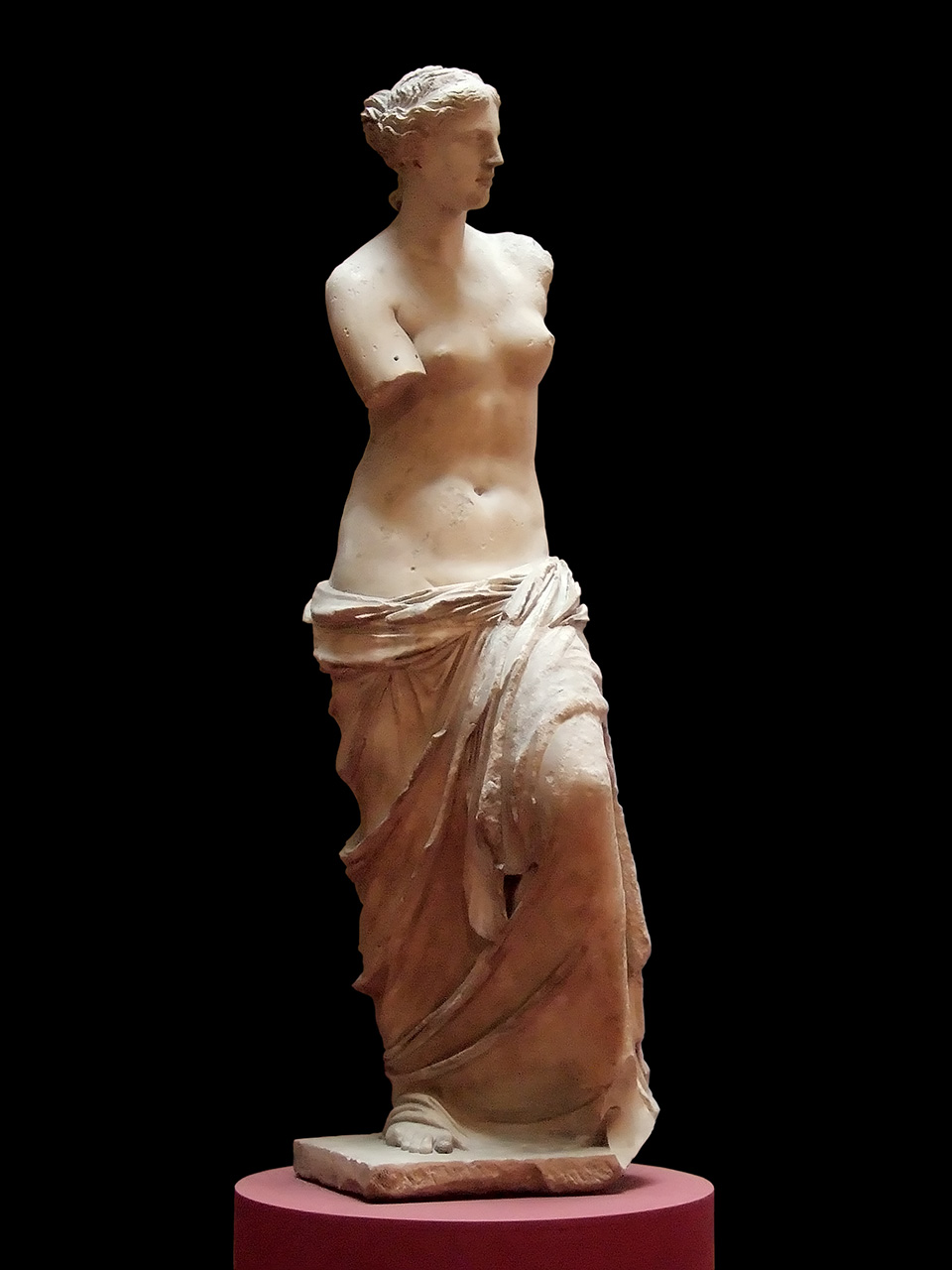
    6) Aphrodite of Milos. Alexandros of Antioch(?)


    7) Concerto for Harpsichord in D minor, BWV.1052 - Adagio (in G minor). J. S. Bach
    The slow movement is in a form which only Bach has brought to perfection. . . We may call it the modulating ground bass. [After the opening orchestral ritornello] enters the dialogue between the solo and the upper strings. The ritornello becomes a ground bass to this dialogue throughout the movement, but it differs from an ordinary ground bass in that its final cadence shifts to a different key each time, and that before each recurrence a connecting link of three bars establishes yet another key for it to start from. At last, of course, it comes round to the tonic; the final cadence is expanded, . . . and the movement closes, as it began, with the bare ground bass. [Tovey, 183]


    Tovey, Donald Francis. Essays in Musical Analysis. (Six Volumes.) Volume II: Symphonies II: D Minor Clavier Concerto. Oxford University Press. London. 1935.

    Wednesday, August 18, 2010

    Book Review: Three Philosophical Poets

    Three Philosophical Poets: Lucretius, Dante, Goethe by George Santayana. 1910.

    Writing about philosophy is not so easy, likewise for poetry. Writing about their intersection is, then, quite the challenge. It would seem that while many words are needed to provide context and explication, only a very few will impart a sense of clarity. Likewise living in and observing the world are also required for making the most of these subjects. How does one study these worlds, then? Diligently and over a long period of time. Maybe that's not such a useful answer, but it's probably true. There is plenty of help to be had, but the quality and approaches of that help widely varies. Of philosophy and poetry both it is trivial to find general books, "On Poetry" or "Great Poetry" or even "Writing Poetry" and books too specific. The academic world is particularly good at providing the specifics: I'm sure someone has scanned every line of Lucretius and I'm sure there's an article on Aristotelian influence on 17th century pre-Metastasian opera libretti. I pass over entirely the 20th century "schools" of approach which mean to deconstruct and then, at best, to cobble back together again. Murdering a poem to dissect it (and then dissecting it) and getting lost on a philosophical byway is not the path toward appreciating, and using and living, art and philosophy. What is required is something which broadens your horizons and gets out of the way.

    As such I'm grateful to whoever at Barnes and Noble decided to re-issue George Santayana's Three Philosophical Poets: Lucretius, Dante, Goethe. The text has passed into the "public domain" in American copyright law and I understand it is now available from a few presses. It is also available for free online, here. I bought it from Barnes and Noble for about seven dollars. Nonetheless I had not heard of it before and coming on the heels of our recent inquiry here into philosophy and art, I gladly snatched it up. I didn't really know what I was in for as I am not terribly familiar with Santayana and his work.

    Opening up to the following page from the section on Dante I read:

    Love itself dreams of more than mere possession; to conceive happiness, it must conceive a life to be shared in a varied world, full of events and activities, which shall be new and ideal bonds between the lovers. But unlawful love here cannot pass out into this public fulfillment. It is condemned to be mere possession–possession in the dark, without an environment, without a future. It is love among the ruins. And it is precisely this that is the torment of Paolo and Francesca–love among the ruins of themselves and all else they might have had to give to one another. Abandon yourself, Dante would say to us,–abandon yourself altogether to a love that is nothing but love, and you are in hell already. Only an inspired poet could be so subtle a moralist. Only a sound moralist could be so tragic a poet. [p. 93]


    Ary Scheffer. 1855. Oil on Canvas.

    I was sold. Yet I'm not sure what to say in this "review." Perhaps just a few remarks about and selections from each section will suffice. Pardon my if I quote liberally, as I wish not to summarize but to pass on some of Santayana's beautiful analogies and descriptions. There would be little point for me to summarize Santayana explaining Lucretius.

    The book is in fact a collection of six lectures "with a few additions" read at Columbia University in February, 1910 based on one of Santayana's courses. The preface begins on a note of frank modesty:
    . . . my book can make no great claims to learning. It contains the impressions of an amateur, the the appreciations of an ordinary reader. . . I am no specialist in the study of Lucretius; I am not a Dante scholar nor Goethe scholar. My excuse for writing about them, notwithstanding, is merely the human excuse which every new poet has for writing about the spring. They have attracted me; they have moved me to reflection; they have revealed to me certain aspects of nature and philosophy which I am prompted by mere sincerity to express, if anybody seems interested or willing to listen. What I can offer the benevolent reader, therefore, is no learned investigation. It is only a piece of literary criticism, together with a first broad lesson in the history of philosophy–and, perhaps, philosophy itself.
    What a wonderful sentiment, one which I'm tempted to adopt as the premise for this blog. Three Philosophical Poets is no treatise or dissertation. It is not a mighty tome assembled to change the world or cudgel you into the author's viewpoint nor a desperate attempt to cull something new from works which have been extensively written on, in one case for thousands of years. Rather, reading Three Philosophical Poets is like listening to a finely mannered house-guest who begins, "Isn't it funny how Lucretius. . ." and then proceeds to share his brilliance and insight. It is a brilliance which does not dazzle, though, but rather which illuminates heretofore invisible vistas. Regarding philosophy, often thought of as a ponderous topic, while we will delve to its roots we won't muck about there for long. Santayana does not really consider all of the myriad implications of every statement of these books. We are looking at essentials here, for the most part, and likewise Santayana, while he stops to say what an author misses, is mostly pulling out the best of each work.

    The introduction begins no less encouragingly than the preface, "The sole advantage in possessing great works of literature lies in what they can help us to become. . . We can neither take away nor add to their past value or inherent dignity. It is only they, in so far as they are appropriate food and not poison for us, that can add to the present value and dignity of our minds." What an extraordinary sentiment. It will be the author's goal not only to discuss the three major schools of European philosophy and the greatest artist and exponent of each, but to suggest they are compatible. The first is Lucretius, to whom the world is one great machine and whose De Rerum Natura describes the birth and nature of all things. This is the school of naturalism, of materialism in natural science, humanism in ethics. A thousand years later Dante comes to us, "who partly understands his destiny; his own history and that of the world are transfigured before him and, without ceasing to be sad, become beautiful. The raptures of a perfect conformity with the will of God, and of union with Him, overtake him in his prayers." This is supernaturalism.

    "Still later, the Teutonic races that had previously conquered Europe have begun to dominate and understand themselves. They have become Protestants, or protesters against the Roman world. . . They turn successively to the Bible, to learning, to patriotism, to industry, for new objects to love and fresh worlds to conquer; but they have too much vitality, or too little maturity, to rest in any of these things. A demon drives them on; and this demon, divine and immortal in its apparent waywardness, is their inmost self. . . Their will summons all opportunities and dangers out of nothing to feed its appetite for action; and in that ideal function lies their sole reality. Once attained, things are transcended. Like the episodes of a spent dream, they are to be smiled at and forgotten; the spirit that feigned and discarded them remains always strong and undefiled; it aches for new conquests over new fictions. This is romanticism. The greatest monument to this romanticism is Goethe's Faust." [p.7]

    Perhaps you can see why I have taken the liberty of quoting Santayana at length. Yet Santayana is not merely going to catalog and describe these movements for us and quickly delves into a great question: why are the most "adequate and probably most lasting expositions" of these three schools of philosophy made by poets? "Are poets, at heart, in search of philosophy? Or is philosophy, in the end, nothing but poetry?" A fine question we recently pondered.

    If philosophy is simply an investigation into truth, then no, there is not so much in common between philosophy and poetry. Epicurus, St. Thomas Aquinas, and Kant were not poets. ("leafless forests" he calls them.) Santayana reminds us how even Lucretius himself said his verses relative to his ideas were like the putting of honey on the rim of the cup of medicine for a child. This statement which seemingly refutes any connection between art and poetry, Santayana sees to unite them. Yes, philosophy is along and arduous path but the order it reveals is beautiful, and that same beauty is forever the aim of the poet. Philosophy is but a tool and not the end itself, the end is insight, or theory or θεωρία, "a steady contemplation of all things in their order and worth."
    Such contemplation is imaginative. No one can reach it who has not enlarged his mind and tamed his heart. A philosopher who attains it is, for the moment, a poet; and a poet who turns his practised and passionate imagination on the order of all things, or on anything in the light of the whole, is for that moment a philosopher. [p.9]
    This sounds plausible and good, but how can the poet be a good poet if he is a philosopher, philosophy being such a reasoned and dense thing, and poetry, "something winged, flashing, inspired?" Poetry exists in the increase and relaxation of tension, existing essentially in moments. Most verse exists to carry us to those moments, moments of poetic insight and perspective. Is not some of it merely mechanical, designed to bring us somewhere else and not significant in itself? It is the vulgar moment that knows only itself. Yet Santayana does not delve into practical concerns about the length of a poem and whether one can really take it all in at once. We might infer that there ought not to be "vulgar lines" or that they ought seamlessly carry us over into moments of greater insight and intensity, albeit brevity.

    So if the brief moment is significant for being of greater scope, "how much more poetical ought a vision to be which was pregnant with all we care for? Focus a little experience, give some scope and depth to your feeling, and it grows imaginative; give it more scope and more depth, focus all experience within it, make it a philosopher's vision of the world, and it will grow imaginative in a superlative degree, and be supremely poetical." The poet-philosopher has to imagine, symbolize, and give expression to this, and we must strive to suspend it all at once in thought before us.
    As in a supreme dramatic crisis all our life seems to be focused in the present, and used in colouring our consciousness and shaping our decisions, so for each philosophic poet the whole world of man is gathered together; and he is never so much a poet as when, in single cry, he summons all that has affinity to him in the universe, and salutes his ultimate destiny. It is the acme of life to understand life. The height of poetry is to speak the language of the gods. [p. 12] [1]
    Sometimes the poet may err and his work may be lose sight of the part or the whole and sometimes we are unable to live in the poetic moment, for we do not speak the poet's language or cannot keep in our head at once what he asks us to. Yet this is such a beautiful sentiment of what poetry and philosophy should be, rather, could be: a synthesis of all that is significant made beautiful.


    I. Santayana's sweep in describing the poems and philosophies of Lucretius, Dante, and Goethe is remarkable. One would not have expected Lucretian Epicurean materialism to be presented with such vigor and enthusiasm in the 20th century. Santayana is downright persuasive in presenting the world of De Rerum Natura, and "presenting the world of" is exactly what he does for the three works. He does not give us dry criticism or line-by-line analyses. He presents the poem with the zest of a discoverer or delighted observer, and with such clarity we forget the abstract nature of what seems so clear:
    One of the first things that impresses the poet, the man of feeling and reflection, is that these objects that people the world all pass away, and that the place thereof knows them no more. Yet, when they vanish, nothingness does not succeed; other things arise in their stead. Nature remains always young and how in spite of death at work everywhere; and what takes the place of what continually disappears is often remarkably like it in character. Universal instability is not incompatible with a great monotony in things; so that while Heraclitus lamented that everything was in flux, Ecclesiastes, who was also entirely convinced of that truth, could lament that there was nothing new under the sun. [p.18]
    Such observation gave birth to the notion of all we observe being passing forms of a permanent substance, whether we call it change, or "the triumph of time," or put it as Lucretius did, that nothing arises in the world not helped to life by the death of some other thing:
    Lucretius,1.264-265
     Alid ex alio reficit natura, nec ullam
    Rem gigni patitur, nisi morte adiuta aliena.

    We see this flux in Lucretius, that between Love and Strife, most notably as the revolutions between Venus and Mars. Ruling the universe together, the former cultivating the latter ravaging. This natural flux cares not for particulars but only the movement itself. In Lucretius life is the result of a chance, the "acme of the dance of atoms," and the philosopher at the top of the wave, the "foam in the rolling tempest; and as the wave must have risen before he bursts into being, all that he lives to witness is the fall of the wave."

    Fear not death, then, but what a disconsolate life. Anyway what is feared is not death, or even suffering, but "the defeat of a present will directed upon life and its various undertakings." [p. 41] Indeed life to Lucretius is a mad one.

    Yet Santayana has a few regrets of Lucretius, who was slightly too blind to pleasures in life, like friendship, and something with which to reinforce the materialistic view: supernaturalism. The emotions which Lucretius associated with his atoms and void, with his religious denials and his abstentions from action, are emotions necessarily involved in life."


    II. Santayana considers the essence of supernaturalism that things are to be understood by their uses or purposes and not by their antecedents: that what is best ought to be. "The use of the body is the mind, whatever the origin of the body may be." This concept he traces to Socrates but it is in Dante that the idea had its greatest expression. In Dante the Aristotelian ethics, the Neoplatonic cosmology, the living Hebraic and Church traditions, and the parallel classical tradition, converged. He fused all into one moral unity and one poetical enthusiasm. The fusion was perfect "between the personal and the traditional elements. He threw politics and love into the melting-pot, and they, too, lost their impurities and were refined into a philosophic religion."

    "Throughout the Divine Comedy, meaning and meaning lurk beneath the luminous pictures; and the poem, besides being a description of the other world, and of the rewards and punishment meted out to souls, is a dramatic view of human passions in this life; a history of Italy and of the world; a theory of Church and State; the autobiography of an exile; and the confessions of a Christian, and of a lover, conscious of his sins and of the miracle of divine grace that intervenes to save him." [p. 82]

    Dante and Virgil in Hell, or The Bark of Dante. 1822. Eugène Delacroix.

    Dante, then, is not just a philosopher. He looks not at philosophy, but beyond to theology, just as he looks beyond the other woman to Beatrice. Yet still he looks further: "the eyes of Beatrice reflect a supernal light. It is the ineffable vision of God, the beatific vision, that alone can make us happy and be the reason and the end of our loves and our pilgrimages."

    III. If there is perhaps too much Dante in the Divine Comedy, and perhaps Dante's world places man in too high a place, such is the essence of Romanticism. The Romantic hero:
    . . . disowns all authority, save that mysteriously exercised over him by his deep faith in himself. He is always honest and brave; but he is always different, and absolves himself from his past as soon as he has outgrown or forgotten it. He is inclined to be wayward and foolhardy, justifying himself on the ground that all experience is interesting, that he springs of it are inexhaustible and always pure, and that the future of his soul is infinite. In the romantic hero the civilized man and the barbarian must be combined; he should be the heir to all civilization, and, nevertheless, the should take life arrogantly and egotistically, as if it were an absolute personal experiment. [p.113]

    Santayana's journey through the many episodes and faces of Faust is exciting and brimming with insight, but it won't do to recap it here. Nonetheless, the passage on Helen is particularly good:
    It is evidence of Goethe's great wisdom that he felt that romantic classicism must be subordinated or abandoned; that Helen must evaporate. . . Perhaps in the commonwealth he is about to found, Faust would wish to establish not only dykes and freedom, but also professorships of Greek and archaeological museums. And the lyre of Euphorion, which is also left us, may signify that poems like Byron's Isles of Greece, Keats's Grecian Urn, Die Götter Griechenlands of Shiller, and Goethe's own classical pieces will continue to enrich European literature. This is something, but not enough to lift Faust's immense enthusiasm for Helen above a crass illusion. That dream of a perfect life to be lived according to nature and reason, would have ended in a little scholarship and a little pedantry. Faust would have won Helen to hand her over to Wagner. [p. 139]
    It is the pursuit not the end which defines the Romantic view: "everything is worth pursuing, and nothing brings satisfaction–save this endless destiny itself." Yet while the Romantic hero was just born Mephistopheles is ancient. Willing evil, championing darkness, he reminds us of the folly of living. Yet "while everything falls successively beneath his sickle, the seeds of life are being scattered perpetually behind his back. The Lucretian Venus has her innings, as well as the Lucretian mars. The eternal see-saw, the ancient flux, continues without end and without abatement." [p. 128]

    It was a perceptive mind that saw the philosophical thread running through Lucretius, the poet of nature, Dante, the poet of salvation, and Goethe, the poet of life, and the contrasts of substance, morals, and immediacy in their works. Great works and artists all, but in combination! Lucretius sees all in proper place, Dante the distinctions of all forms of good and beauty, and Goethe the passion of the present.


    What would a work perceptive of all three be! Santayana waited for the poet who would make it, and so do we. In the meanwhile we have quite a bit to work with.


    [1] One recalls a similar sentiment from Beethoven in a letter to a young pianist: "Do not only practice your art, but get at the very heart of it: this it deserves, for only art and science raise men to the God-head." [link]